Who Can Be Whop? The structural questions behind DeFi yield integration in fintech
Stani Kulechov on LinkedIn “Defi is supercharging Fintech” as he announced the integration of Whop Treasury. At Singapore TOKEN2049 last October, he framed embedded DeFi more broadly as a “trillion-dollar opportunity” for fintechs.
Here in Singapore where Grab, Sea Group, and a generation of ASEAN super-apps have spent years burning capital to build financial services, that framing landed differently for me.
I’ve written previously about the unit economics challenges facing ASEAN fintechs like MoMo and the structural tension between payments scale and lending profitability. So when Whop launched Treasury on March 25, 2026, routing creator balances into DeFi yield through Tether’s infrastructure, the question I asked was not “will this work for Whop?” It was:
What type of fintech can actually repeat this, and where in APAC does the structure exist to do it?
What Whop Treasury actually does
Whop is a creator commerce platform: digital products, communities, courses, SaaS, coaching, operating as a Merchant of Record with payments infrastructure across 195 countries. The scale is real: $3.1B+ made by sellers, 199,555 sellers, and 20.7M users on the live counter as of April 2026. (Whop’s homepage separately lists 2.6M registered “businesses” — likely including dormant storefronts. Sacra’s Feb 2026 profile reported ~$100M monthly GMV and $2.67B cumulative lifetime GMV at the time.)
In February 2026, Tether Ventures invested $200M at a $1.6B valuation. A month later, Whop launched Treasury.
Here is what happens when a seller opts in:
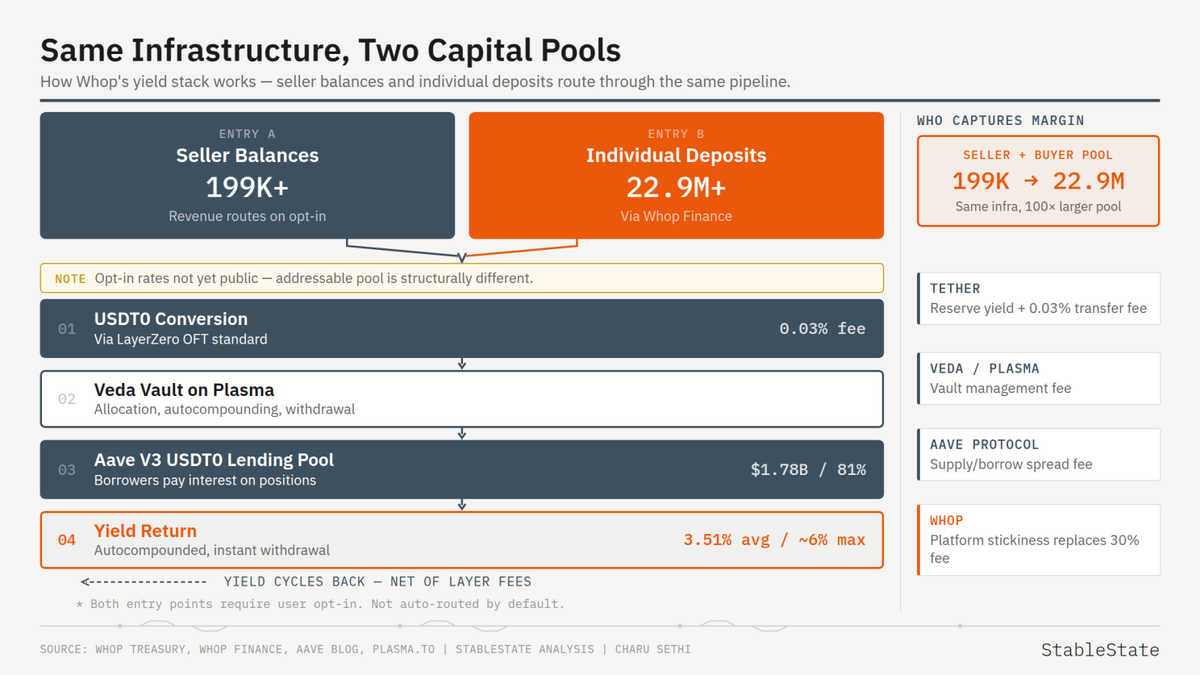
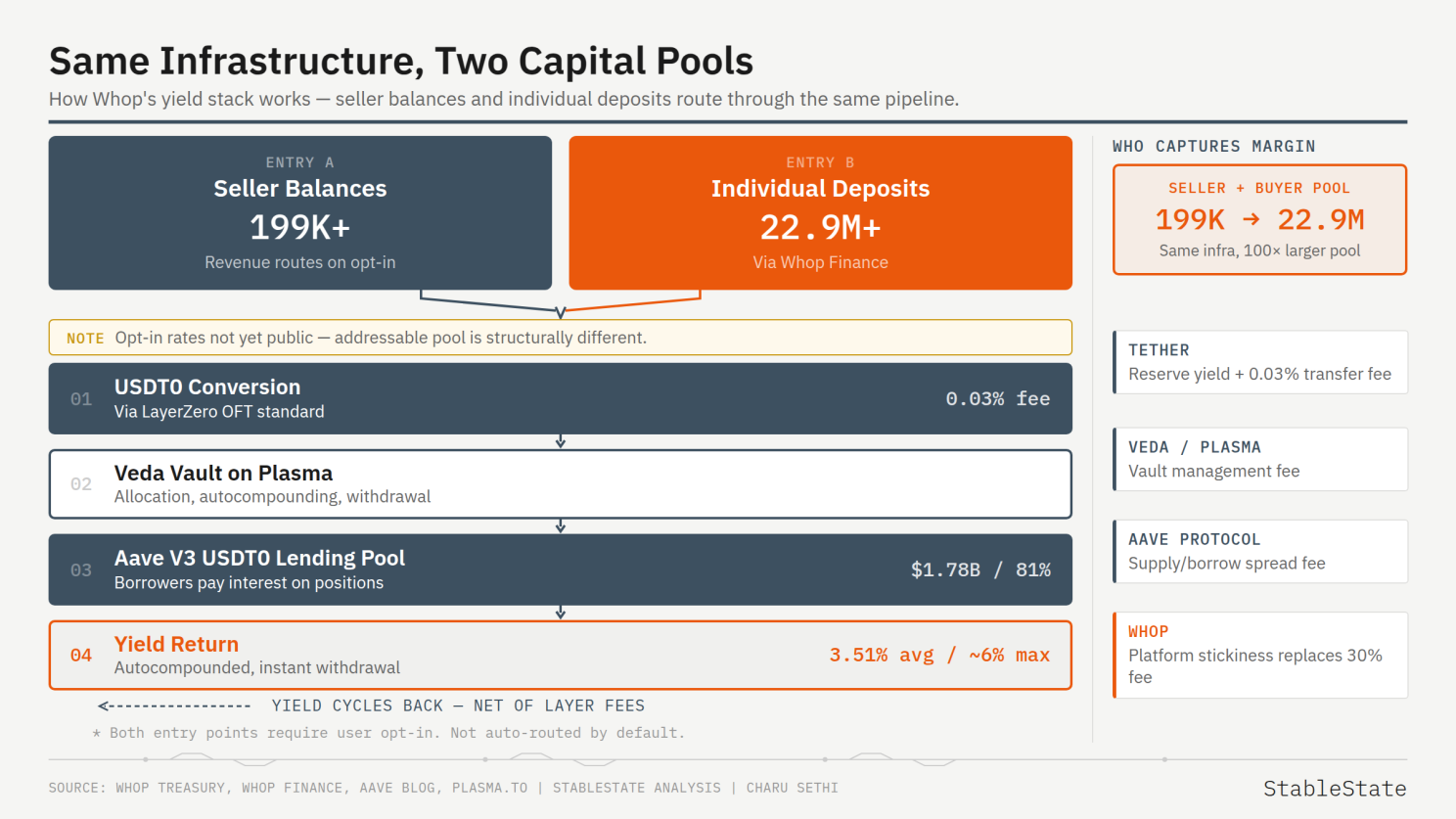
- Balances convert to USDT0, the omnichain version of USDT built on LayerZero’s OFT standard, $70B+ in cross-chain transfers since January 2025
- USDT0 routes through a Veda vault on Plasma into Aave V3’s USDT0 lending pool $1.78B supplied, 83.7% utilization, 3–6% APY (last 6m), Aave’s second-largest market globally
- Yield comes from real borrower demand, collateral depositors borrowing USDT0 for leverage and yield strategies
- The user sees “up to 6% APY.” The infrastructure handles conversion, routing, allocation, autocompounding, and instant withdrawal
This is not limited to sellers. Whop launched Whop Finance alongside Treasury. Every Whop account holder can hold USDT and earn yield through the same infrastructure. That means the addressable pool is not 200K sellers. It is potentially 20M+ users. Opt-in rates are not yet public, but the growth ceiling is structurally different from a seller-only product.
Where the margin sits. Tether earns reserve yield on the USDT locked on Ethereum backing every USDT0 token — $122B+ in US Treasury holdings. USDT0 carries a documented 0.03% transfer fee. Veda and Aave extract their own fees from the yield layer. The exact fee split for Whop Treasury is not publicly disclosed, but the architecture positions multiple entities to capture thin margins that compound across layers.
Why this is different from payments orchestration. Orchestration routes value faster between points. That compresses toward thinner margins over time, as every payments company knows. The margin that compounds here is in programmable liquidity: the smart contract logic that transforms idle balances into active lending positions, autocompounds yield, and manages withdrawal liquidity without human intervention.
Why this worked structurally for Whop
Three properties converged.
Idle balances exist by default. Creator revenue sits in Whop until withdrawal. Payouts carry fees from $2.50 to $23. The float between earning and withdrawing is structural. How much converts to Treasury depends on opt-in rates, that data is not yet public.
No lending arm competes. Whop operates regulated payments infrastructure : MoR, KYC, multi-PSP orchestration. But it has no banking license and no lending business. DeFi yield is additive, not competitive with existing margin.
Platform stickiness increases. Creators earning yield have a reason to keep funds on Whop. After eliminating its 30% marketplace fee in May 2025, Treasury adds a new margin layer and turns Whop from a conduit where capital flows through into a platform where capital stays. Individual user access extends this further: buyers who earn yield on idle balances have a reason to keep funds on Whop too, not just sellers.
The three-token architecture underneath
Tether operates three tokens serving three regulatory needs. USDT ($184B+ circulation, global reserve asset). USDT0 ($4B+ cross-chain transfers via LayerZero OFT — the transport protocol powering Whop Treasury, 0.03% transfer fee). USAT (US-regulated, issued by Anchorage Digital Bank under OCC supervision, GENIUS Act compliant). At TOKEN2049 in Singapore, which I attended, CEO Paolo Ardoino set a $1 trillion target for USAT within three to five years and confirmed: “USDT and USAT will be fully interoperable, one-to-one swappable. You can have a super seamless user experience that will mask the complexity of having two products at the same time.”
Three tokens, three regulatory regimes, one shared infrastructure underneath. Whop routes through USDT0 today. US users could switch to USAT, potentially without changing the yield infrastructure. The compliance layer swaps. The programmable liquidity layer stays constant. This gives Tether regulatory routing capability that single-token issuers cannot replicate. Right now USAT sits at $37.76M market cap on Ethereum only (DefiLlama) against USDC’s $77.8B across ten chains (DefiLlama). But with full USDT-USAT interoperability and Tether’s $184B distribution network behind it, that gap could close faster than the market expects.
What this means and where it gets complicated
Fintechs integrating DeFi infrastructure is happening. Kulechov projected in 2025 Aave could reach $100B in deposits, placing it among the 35 largest banks globally. Whop Treasury is one of the first live examples at consumer scale.
But repeating it requires asking: what type of liquidity does the platform hold, what regulations govern those balances, and does the platform’s own business model compete for the same capital?
Whop’s structure: idle seller balances, no lending arm, payments-regulated but not a bank, is one scenario. It is not the only one. Different fintech categories hold different types of liquidity under different constraints.
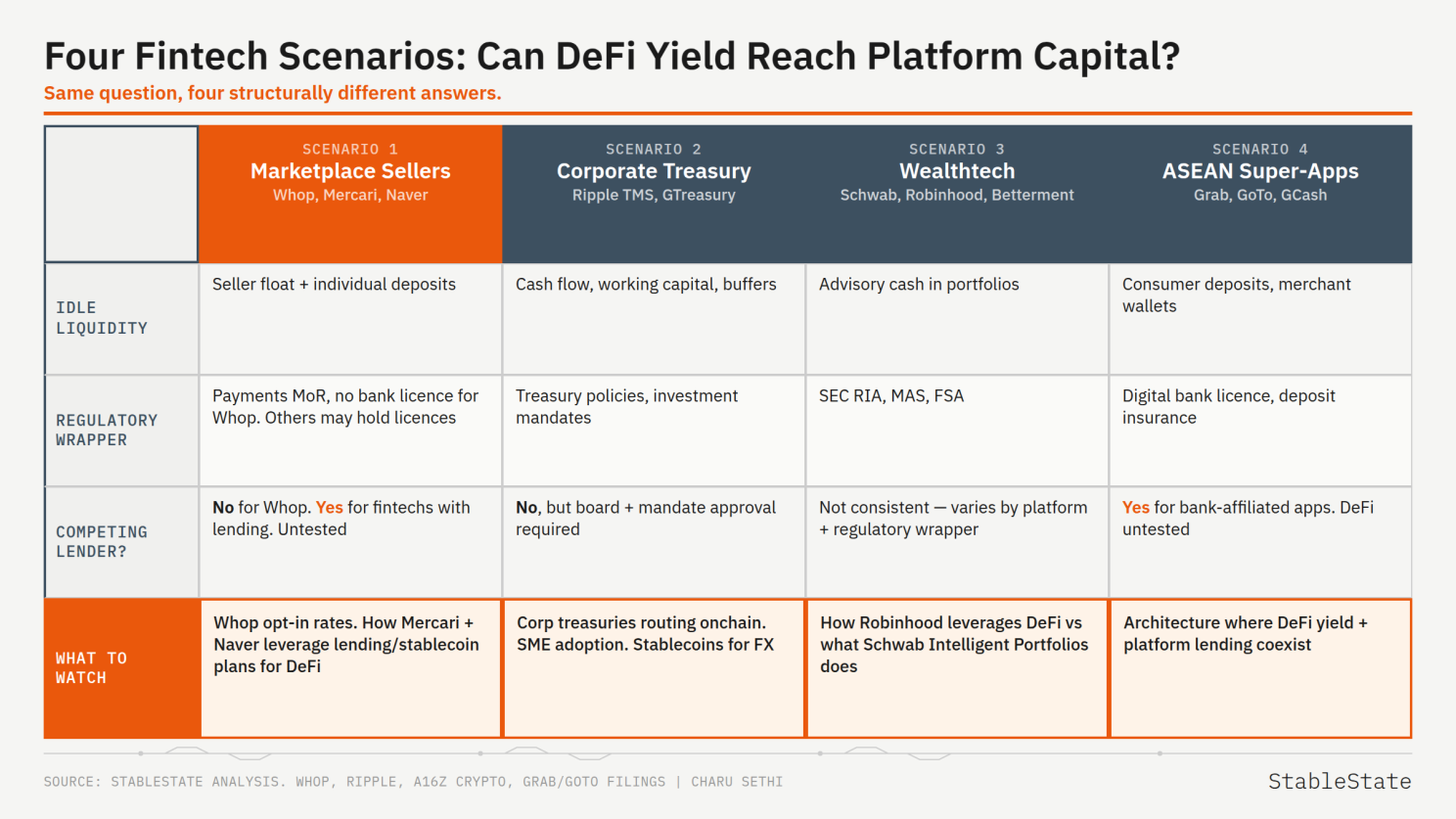
Corporate treasury management. Recently, Ripple Treasury launched what it describes as the first TMS with native digital asset capabilities. Built on Ripple’s $1B acquisition of GTreasury, which facilitated $13T in payments volume in 2025. It lets corporate treasury teams hold and manage stablecoins alongside fiat within a single platform. The roadmap explicitly includes “24/7 yield on idle cash through overnight repo, powered by stablecoins.” Corporate idle cash is a different liquidity pool from creator platform balances - governed by corporate treasury policies, investment mandates, and in some jurisdictions fiduciary requirements on cash management. The regulatory surface is different from Whop’s. But the structural logic is the same: idle capital that could be earning yield, connected to onchain infrastructure.
Wealthtech and robo-advisors. Platforms like Schwab Intelligent Portfolios, Wealthfront, and Robinhood Strategies hold cash allocations within automated portfolios. Schwab sweeps ~10% of its $80B+ AUM into bank deposits earning 3.27% APY, monetising the spread rather than charging advisory fees. Wealthfront pays 3.30% on its cash accounts. DeFi lending pools and vaults can pay more on the same dollar. a16z’s 2026 trends report identifies this: stablecoin cash allocations and tokenized money market funds expanding yield possibilities. Whether these platforms can bridge that gap depends on the regulatory wrapper. The US and Singapore are taking structurally different approaches. SEC-registered RIAs face a fiduciary standard that requires justifying smart contract and custody risk. MAS in Singapore is building the infrastructure from the other direction, Project Guardian is actively piloting institutional DeFi with JPMo and mandates guardrails. Whether DeFi yield can touch advisory cash depends on the specific regulatory wrapper, a question that has not been tested at scale.
Marketplace seller balances, the Whop-adjacent cases. Any platform where sellers hold revenue before withdrawal has idle float. Mercari in Japan (C2C marketplace, MerPay wallet, 1.35M merchants). Coupang in Korea (largest e-commerce, merchant settlement balances). Naver Smart Store in Korea (KRW 22.7T in Q3 2025 through Naver Pay). The structural similarity to Whop is clear, but many of these platforms are building their own lending products (Naver Financial offers BNPL, MerPay has deferred payment), which means the idle float is increasingly being deployed internally.
ASEAN super-app fintechs with lending arms. This is where the structural tension exists. Grab’s GXS Bank holds $1.6B in deposits, lends through a $1.18B portfolio, and acquired Validus Capital in April 2025. While Grab users may be able to hold and transact with stablecoins such as StraitsX-issued XSGD and XUSD, whether they can participate in decentralised lending pools or DeFi yields is unlikely. GoTo Financial’s GoPay lending grew 84% YoY to EBITDA positive in Q1 2025. GCash disbursed PHP 118B (~$2.1B) in loans in 2023. These platforms turned profitable by building lending. Externalizing deposit yield to DeFi would cannibalize the margin that made them profitable. On the other hand MoMo from Vietnam struggles with unit economics and regulations restrict businesses to hold balances in stablecoins. I talked at length about this in my previous article.
The questions this raises
The Whop integration demonstrates what is architecturally possible. The open questions are about where it is structurally repeatable.
- Can corporate treasury using platforms like Ripple’s TMS route idle cash into onchain yield in alignment with investment mandates, and will their clients’ boards approve it?
- Can wealthtech platforms hold cash allocations in tokenized money market funds or stablecoins under existing investment advisor regulations?
- Can marketplace platforms with emerging lending arms find architectures where DeFi yield and platform lending coexist rather than compete?
- And in markets like Japan and Korea where bank-led stablecoin architectures and interest prohibitions are being written into law , does the opportunity sit in settlement rather than savings?
These are not theoretical questions. Ripple’s TMS launched this week with yield on idle cash on its roadmap. Tether filed trademarks for “KRWT” and “WON TETHER” in Korea. The direction of regulatory travel in GENIUS Act, MiCA, and Japan’s PSA amendment is toward standardized issuance and compliant stablecoin infrastructure.
The architecture is here. The structural variables that determine where it fits are rapidly evolving.
Sources
- Whop Treasury announcement — Whop blog, Mar 25, 2026
- Aave × Whop Treasury — Aave blog, Mar 28, 2026
- Tether invests $200M in Whop — CoinDesk, Feb 25, 2026
- Whop company profile — Sacra, Feb 2026
- Aave Plasma USDT0 pool data — Plasma.to, Nov 2025
- USDT0 developer documentation — transfer fee, technical specs
- Ripple Treasury Management launch — Ripple press release, Apr 1, 2026
- a16z 2026 trends: stablecoins, RWA tokenization, payments — a16z crypto, Mar 2026
- BlackRock BUIDL as collateral — CoinDesk, Nov 14, 2025
- JPMorgan MONY launch — JPMorgan, Dec 15, 2025
- USAT US stablecoin — CoinDesk, Sep 12, 2025
- GXS Bank deposits and lending — Fintech News Singapore, Feb 2026
- GoTo Q3 2025 earnings — GoPay lending growth
- Korea stablecoin regulation / Tether KRWT trademarks — KoreaTechDesk, Dec 2025
- Kulechov TOKEN2049 remarks — CCN/Yahoo Finance, Oct 2, 2025