The Stablecoin Licences that Hong Kong issued, and the Edges It Left Open
Two licensees, three distribution tiers, and the opportunity zones taking shape around the regulated perimeter
TL;DR
With practitioner perspectives from Shih Yun Chia (CEO, VerifyVASP), and Etelka Bogardi (Partner, Reed & Smith).
- Hong Kong granted its first two stablecoin issuer licences on April 10, 2026: HSBC and Anchorpoint Financial (Standard Chartered, HKT, Animoca Brands). HSBC targets H2 2026, Anchorpoint Q2 2026.
- Three structural decisions define the regime: bank-led issuance, reserve economics that reward the issuer, and a customer-perimeter framework rather than an allowlist.
- The foundational rule: only HKMA-licensed stablecoins can be offered to retail. USDC, USDT, and USDGO are restricted to professional investors (HK$8M+ portfolios or institutional equivalents).
- Distribution is forming across three tiers: licensed banks, SFC-licensed VATPs and tokenisation operators (OSL, AlloyX), and stablecoin payment fintechs operating outside the perimeter (RedotPay, Reap, Thunes, KAST).
- The framework is built; the product layer is not. The next eighteen months will decide whether HKD stablecoins matter beyond their initial use cases.
On April 10, 2026, the Hong Kong Monetary Authority granted its first two stablecoin issuer licences under the Stablecoins Ordinance (Cap. 656). HSBC and Anchorpoint Financial Limited are the licensees; Anchorpoint is the joint venture led by Standard Chartered with HKT and Animoca Brands. Both are anchored to note-issuing banks. Neither stablecoin is live yet. HSBC is targeting H2 2026, Anchorpoint a phased rollout from Q2 2026.
The interesting question is what these licences actually started.
Three things to read from the licensing decisions:
- The HKMA chose to anchor digital money issuance to the institutions that already issue physical Hong Kong dollars. Bank-led by intent.
- The economics that make the licence valuable are different from the economics that make banknote issuance valuable. Reserve income is the new variable.
- The distribution architecture taking shape across HSBC, Anchorpoint, OSL Group, AlloyX, and a parallel layer of stablecoin payment fintechs is what determines whether bank-issued HKD stablecoins matter beyond their initial use cases.
Why these two banks
Eddie Yue, Chief Executive of the HKMA, framed the selection in his April 10 inSight piece as “distinct use cases with viable business plans,” institutional risk management, and deep AML infrastructure. The regulator was picking the most defensible applicants, not the most aggressive.
Both licensees sit on top of an unusual feature of Hong Kong’s monetary system: banknotes are issued by three private commercial banks (HSBC, Standard Chartered, and Bank of China (Hong Kong)) under a currency board mechanism, not by a central bank. To put a banknote into circulation, a note-issuing bank deposits an equivalent amount of US dollars with the HKMA’s Exchange Fund and receives a Certificate of Indebtedness in return. The CI is non-negotiable, cannot be traded or pledged, and earns no interest.
The stablecoin reserve framework is structured differently. Under the HKMA Supervision Guideline, a licensed issuer must hold reserves equal to 100% of outstanding tokens, in a segregated trust account. Section 15 of Schedule 2 prohibits paying interest to holders. Reserve income accrues entirely to the issuer.
On the reserve mechanism alone, digital HKD issuance is materially more profitable than physical HKD issuance. Same currency, same banks, two issuance rails, different reserve economics.
The economic logic mirrors what makes Tether and Circle profitable. Maggie Ng, General Manager and Head of Wealth and Personal Banking Hong Kong at HSBC, has referenced merchants offering rewards as part of the H2 2026 launch. That is the workaround for the yield prohibition; issuer-level interest is banned, but distribution incentives are permitted.
“Equivalent treatment for overseas regulated stablecoins was raised during the consultation but wasn’t taken up. While the local licensing system gets fully up and running, I expect the HKMA will hold the line on professional-investor-only access for foreign stablecoins, with broader recognition unlikely to be on the agenda soon.
The SFC’s shared order book framework doesn’t change that; the perimeter on who can issue, and who can be offered to, sits separately from how liquidity is connected.“ - Etelka Bogardi, Partner, Reed & Smith
The regulator’s choice signals what kind of stablecoin Hong Kong is willing to underwrite. One that inherits bank-grade risk management, not one that can potentially lose oversight.
Who wasn’t in the room
The first licensing round did not include Ant Group’s Hong Kong subsidiary, JD Coinlink, or any other mainland-linked applicant — despite JD Coinlink being one of the three named participants in the HKMA’s stablecoin issuer sandbox. Two events from late 2025 explain the gap: the FT reported in October that the People’s Bank of China and the Cyberspace Administration of China had directed Ant Group, JD.com, and other mainland-linked tech firms to suspend their Hong Kong stablecoin pilots over monetary sovereignty concerns. In November, the PBOC and 13 other ministries jointly reaffirmed that stablecoins are illegal virtual currencies onshore.
This is not the HKMA blocking mainland-linked firms. It is the mainland blocking them. Bank of China (Hong Kong), the third note-issuing bank, has correspondingly stayed out of FRS issuance entirely.
The licensee list (even in future) will need to be aligned with Beijing’s stance. Whether a mainland-linked stablecoin ever issues from Hong Kong is a political question, not a regulatory one.
The customer-perimeter regime
The HKMA’s AML/CFT Guideline, effective from August 1, 2025, defines how these stablecoins will operate in practice. The architecture is more specific than the strict-KYC framing in most commentary.
VerifyVASP is one of the leading Travel Rule solution providers globally, operating compliance infrastructure for over 150 VASPs with $400B in transactio volume. CEO Shih Yun Chia shared his perspective on how Hong Kong’s customer-perimeter regime translates into operational practice for HKMA-licensed issuers and their counterparties.
On the operational architecture and how the Travel Rule applies in practice:
“HKMA obliges zero-threshold in Travel Rule information transmission requirements. Also, the model makes the issuer an active compliance participant, not just a mint-and-burn entity.
Operational handshake will start from the establishment of counterparty relationships, subject to stringent counterparty due diligence based on Wolsberg standard. Per each transfer, counterparty will be verified before exchanging Travel Rule information. Then, Travel Rule data will be submitted and verified, before on-chain execution. Post-transfer monitoring and record keeping will follow.” — Shih Yun Chia, CEO, VerifyVASP
On which jurisdiction is most likely to emerge as Hong Kong’s natural Travel Rule counterparty:
“I would point first to South Korea, with Singapore and Japan close behind. Korea has one of the deepest regulated VASP markets in Asia, early Travel Rule implementation, high exchange connectivity, and strong stablecoin trading demand. Singapore is the most natural institutional corridor because of MAS-regulated DPT firms and banking connectivity, while Japan is highly relevant because its Travel Rule framework also covers stablecoins and has strong regulatory alignment.”— Shih Yun Chia, CEO, VerifyVASP
A defensible architecture but a slow one. Licensees inherit obligations that retail users will not see and that competitors operating outside the perimeter do not carry.
The Distribution Architecture
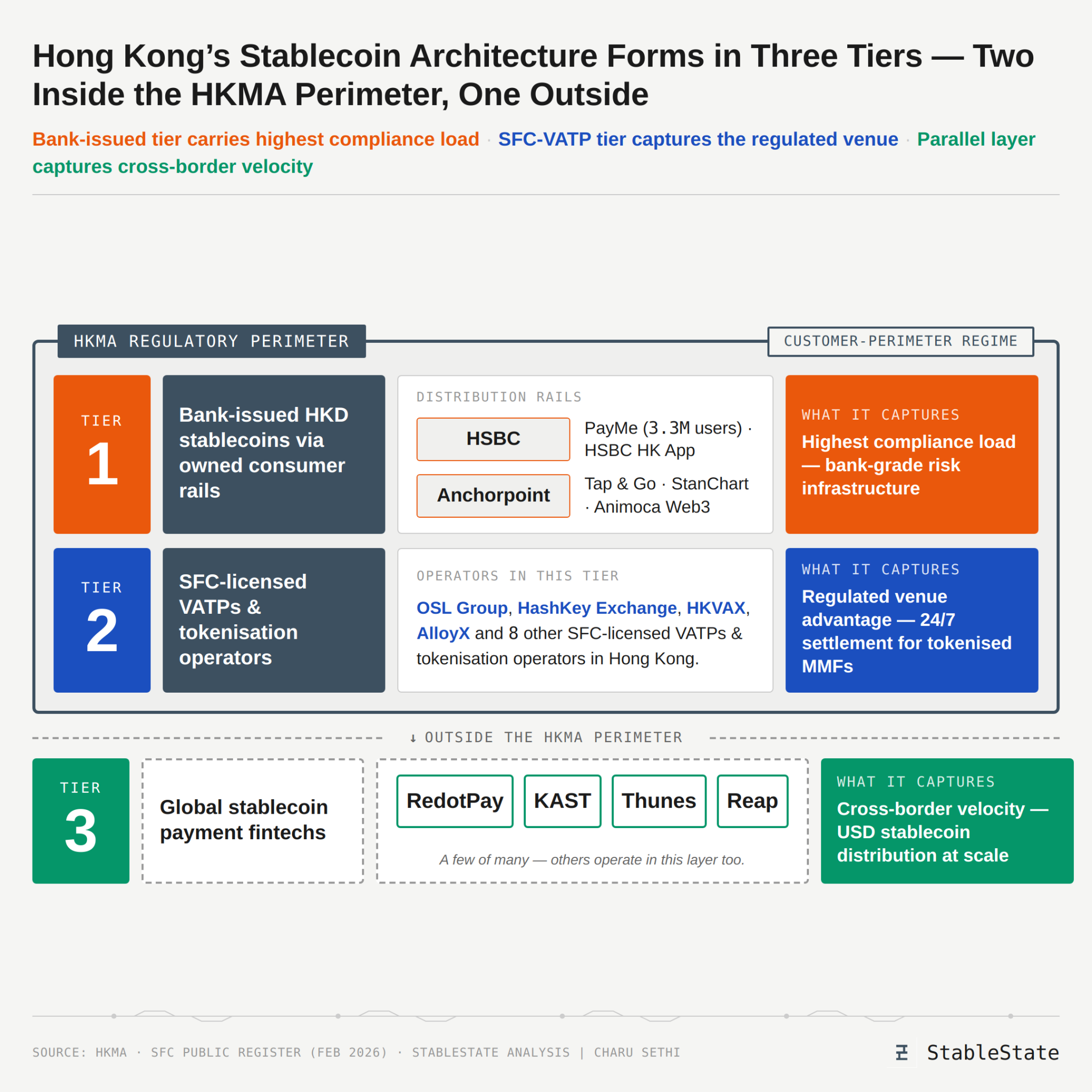
The licensing announcement is the headline. The distribution choices are where the next twelve months will be decided. Hong Kong’s stablecoin distribution is forming as a three-tier architecture, with OSL Group as the most strategically interesting player.
Tier 1: Bank-issued HKD stablecoins via owned consumer rails
- HSBC will distribute through PayMe (3.3 million users) and the HSBC HK App. Three named retail use cases at launch: P2P transfers, P2M payments, and tokenised investment subscription. The stablecoin sits inside a tokenised asset stack HSBC already operates, including HSBC Orion for digital bonds, the HSBC Gold Token for retail since March 2024, and tokenised deposits via Canton.
- Anchorpoint will distribute HKDAP through HKT’s Tap & Go for retail, Standard Chartered’s institutional banking network for B2B settlement, and Animoca’s Web3 ecosystem for native digital distribution. CEO Dominic Maffei has said the early phase targets institutions, with retail considered later.
These wallets are entering a saturated consumer payments market. Octopus retains near-universal adult penetration. AlipayHK, WeChat Pay HK, and BoC Pay are established consumer wallets. PayMe and Tap & Go are adding a stablecoin layer to wallets that already compete inside a saturated landscape.
Tier 2: SFC-licensed VATPs and tokenisation operators
A new distribution channel formally opened on April 20, 2026, when the SFC published its framework for 24/7 secondary trading of tokenised SFC-authorised investment products.
- Initial scope is tokenised money market funds. Tokenised bonds and equity funds are not in scope at launch.
- The framework excludes USDC, USDT, USDGO, and other non-HKMA-licensed stablecoins from this settlement role by design.
- Two restrictions converge here. First, the Stablecoins Ordinance and the Financial Secretary’s exemption notice limit unlicensed FRS, including USDC, USDT, and USDGO to professional investors only across all permitted offerors in Hong Kong. Second, the SFC’s April 20 framework further limits the settlement asset for tokenised MMF trades in this specific venue to HKMA-licensed FRS or tokenised deposits from authorised institutions.
The structurally significant feature of the framework is what it excludes; the exclusion of non-HKMA-licensed stablecoins from this settlement role is by design.
OSL Group is the most embedded SFC-licensed VATP in Hong Kong and one of the round-one applicants. It already distributes USDGO, the Anchorage-issued GENIUS Act stablecoin, exclusively in Hong Kong. We cover OSL in a dedicated section below given its strategic distinctiveness.
AlloyX, the Solowin Holdings (NASDAQ: AXG) subsidiary, also sits in this tier as a tokenisation operator. Its Real Yield Token is a tokenised USD MMF with Standard Chartered as off-chain custodian. AlloyX has stated in SEC filings that becoming an HKMA-licensed stablecoin issuer is a strategic objective; the planned token is named AX Coin. AlloyX raised US$100 million in February 2026.
Tier 3: Global stablecoin payment fintechs operating outside the perimeter
Within this tier sit several distinct positions.
Reap, headquartered in Hong Kong since 2018 and holding a TCSP licence and Visa Principal Issuer status, operates as B2B infrastructure , corporate cards collateralised in USDC/USDT, cross-border payments in 18+ currencies, and white-label card-as-a-service that powers other Tier 3 players including RedotPay and Animoca.
RedotPay, also Hong Kong-headquartered with Money Lender and TCSP licences, operates the consumer-facing layer , stablecoin cards and wallets serving 7+ million users with $10B in annualised volume across 100+ markets.
Thunes, Singapore-headquartered with a Hong Kong MSO licence, operates the institutional infrastructure layer — Pay-to-Stablecoin-Wallets in 130+ countries, integrated into Mastercard Move and Swift connectivity for 11,500 banks.
KAST, incorporated in Anjouan and governed by Seychelles law with no Hong Kong licence, operates as a global stablecoin neobank with 1M+ users including in Hong Kong via cross-border availability.
All four operate USD stablecoin distribution outside the HKMA perimeter. They do not compete with HSBC or Anchorpoint for the same customer or use case.
The competitive dynamic between the three tiers is structurally asymmetric. The bank-issued tier carries the highest compliance load. The SFC-VATP tier captures the regulated venue advantage. The parallel layer captures cross-border velocity.
OSL Group: distribution as the durable franchise
OSL Group sits in a structural position no other participant in the Hong Kong stablecoin ecosystem occupies. The first SFC-licensed VATP in Hong Kong, now operating across stablecoin distribution, B2B payments, fiat ramps, and tokenised RWA listings.
The most visible recent milestone is USDGO crossing US$200 million in circulating supply in late April 2026, roughly 75 days after launch. USDGO is issued by Anchorage Digital Bank N.A. under the GENIUS Act, with OSL as the exclusive Hong Kong distributor. The April 22 Circle partnership integrated USDC alongside USDGO as a unified margin asset. OSL BizPay handles B2B enterprise payments. Banxa, acquired January 2026, provides global fiat ramps. On April 17, OSL HK became the first Hong Kong-licensed digital asset platform to list both Matrixdock Gold (XAUm) and Matrixdock Silver (XAGm), broadening the franchise from stablecoin distribution into compliant RWA listings.
OSL did not appear in the first HKMA licence round. The franchise is structured around multi-stablecoin distribution and RWA listings rather than single-stablecoin issuance.
Circle’s May 1 confirmation that it will not issue a Hong Kong dollar stablecoin and will instead seek USDC recognition as a foreign stablecoin is the clearest signal yet that the global USD stablecoin layer intends to live alongside the HKMA perimeter, not inside it.
Whether multi-stablecoin distribution is a more durable franchise than single-stablecoin issuance is the most interesting unanswered question in the Hong Kong stablecoin market right now.
When HKD leaves the perimeter, where the opportunities sit
The Stablecoins Ordinance defines a perimeter inside Hong Kong. The HKMA AML/CFT Guideline ends licensee monitoring at the customer relationship boundary. Once a holder receives an HKMA-licensed HKD stablecoin, nothing prevents them from sending it cross-border, into permissioned DeFi, or to a counterparty wallet outside Hong Kong.
What’s missing is the architecture to help HKD compete in those flows at scale:
- USD stablecoins already dominate cross-border settlement
- The HKMA has not published guidance on permissioned DeFi participation
- Commercial routing structures for HKD into global stablecoin distribution don’t yet exist
In that gap, three opportunity zones are emerging.
Yield wrappers around the zero-yield base layer. Section 15 prohibits issuers from paying interest, so the yield layer is being built adjacent to the stablecoin. Three SFC-authorised tokenised MMF products already operate in Hong Kong:
- Bosera’s HKD and USD MMF tokenised classes via HashKey
- ChinaAMC’s HKD Digital MMF via OSL, with Standard Chartered Trust as custodian
- AlloyX’s RYT on Polygon
Eddie Yue’s April 10 inSight piece names tokenised asset trading and collateral management as use cases for HKMA-licensed stablecoins. What remains undefined is whether more programmatic yield architectures can develop within Section 15.
Compliance and Travel Rule infrastructure. The customer-perimeter regime demands zero-threshold reporting and enhanced due diligence on unhosted wallets. Banks have not historically built on-chain compliance tooling at this granularity. Whether it gets built in-house, licensed from specialists, or assembled through Travel Rule protocol partnerships will shape both the compliance cost curve and the vendor opportunity.
Cross-border interoperability between the regulated HKD perimeter and the global USD stablecoin layer. OSL already partially occupies this zone through USDGO and USDC distribution. Anchorpoint’s HKDAP, with Standard Chartered’s 54-market network, has the structural option to build into the same space. Whether the architecture that emerges is bilateral routing, multi-stablecoin distribution hubs, or permissioned settlement bridges is genuinely open.
None of these zones are guaranteed to open. Each depends on regulatory clarity not yet published and on capital and execution not yet allocated. The question is not whether the HKD perimeter holds inside Hong Kong. It is whether HKD stablecoins can extend beyond Hong Kong meaningfully before USD stablecoins absorb every cross-border use case.
FAQ
Who received Hong Kong’s first stablecoin issuer licences? HSBC and Anchorpoint Financial received the first two HKMA licences on 10 April 2026. Anchorpoint is led by Standard Chartered with HKT and Animoca Brands. Neither stablecoin is live yet. HSBC targets H2 2026; Anchorpoint a phased rollout from Q2 2026.
Can retail investors in Hong Kong buy USDC, USDT, or USDGO? No. Under the Stablecoins Ordinance and the Financial Secretary’s exemption notice, only HKMA-licensed stablecoins can be offered to retail. USDC, USDT, and USDGO are restricted to professional investors (individuals with HK$8M+ portfolios or institutional equivalents) since 1 February 2026.
What is a professional investor in Hong Kong? Under the Securities and Futures Ordinance, a professional investor is an individual with a portfolio of at least HK$8 million, a corporation with assets of at least HK$40 million, or institutions like banks and licensed financial firms. Retail investors are anyone below those thresholds.
Can HKMA-licensed stablecoins pay interest to holders? No. Section 15 of Schedule 2 of the Stablecoins Ordinance prohibits issuers from paying interest. Issuers can offer distribution incentives like merchant rewards, and adjacent yield products (tokenised money market funds) are available through SFC-licensed venues.
Will the HKMA recognise foreign stablecoins like USDC? Foreign stablecoin recognition was raised during the consultation but was not adopted. Senior practitioners expect the HKMA to maintain professional-investor-only access for foreign stablecoins while local licensing becomes fully operational. Broader recognition is unlikely in the near term.
What is OSL Group’s role in Hong Kong’s stablecoin ecosystem? OSL is Hong Kong’s first SFC-licensed VATP. It distributes USDGO exclusively in Hong Kong to professional investors, partnered with Circle in April 2026 to integrate USDC, and operates B2B payments through OSL BizPay alongside fiat ramps via Banxa.
Sources
Primary regulatory sources
- Stablecoins Ordinance (Cap. 656), e-Legislation Hong Kong: https://www.elegislation.gov.hk/hk/cap656
- HKMA Guideline on Supervision of Licensed Stablecoin Issuers: https://www.hkma.gov.hk/media/eng/doc/key-functions/ifc/stablecoin-issuers/Guideline_on_supervision_of_licensed_stablecoin_issuers_eng.pdf
- HKMA Guideline on Anti-Money Laundering and Counter-Financing of Terrorism for Licensed Stablecoin Issuers: https://www.hkma.gov.hk/media/eng/doc/key-functions/banking-stability/aml-cft/Guideline_on_Anti-Money_Laundering_and_Counter-Financing_of_Terrorism_For_Licensed_Stablecoin_Issuers_eng.pdf
- Eddie Yue, “Robust development of the regulated stablecoin ecosystem in Hong Kong,” HKMA inSight, 10 April 2026: https://www.hkma.gov.hk/eng/news-and-media/insight/2026/04/20260410/
- HKMA Register of Licensed Stablecoin Issuers: https://www.hkma.gov.hk/eng/regulatory-resources/registers/register-of-licensed-stablecoin-issuers/
- HKMA stablecoin issuer sandbox announcement, July 2024: https://www.hkma.gov.hk/eng/news-and-media/press-releases/2024/07/20240718-4/
- HKMA Linked Exchange Rate System overview: https://www.hkma.gov.hk/eng/key-functions/money/linked-exchange-rate-system/
- SFC Press Release 26PR59 — framework for secondary trading of tokenised SFC-authorised investment products, 20 April 2026: https://apps.sfc.hk/edistributionWeb/gateway/EN/news-and-announcements/news/doc?refNo=26PR59
Secondary coverage and corporate announcements
- SCMP, “China’s central bank vows to stamp out illegal activities trading stablecoins,” 28 November 2025: https://www.scmp.com/economy/china-economy/article/3334675/chinas-central-bank-vows-stamp-out-illegal-activities-trading-stablecoins
- HSBC Hong Kong, HSBC Gold Token press release, 27 March 2024: https://www.about.hsbc.com.hk/news-and-media/hsbc-gold-token
- Standard Chartered, Anchorpoint joint venture announcement: https://www.sc.com/en/press-release/standard-chartered-launches-hong-kong-dollar-backed-stablecoin-jv-anchorpoint/
- OSL Group, USDGO regulated enterprise stablecoin launch: https://www.osl.com/hk-en/press-release/osl-group-officially-launches-regulated-enterprise-stablecoin-usdgo
- OSL Group, Matrixdock XAUm and XAGm dual-listing on OSL HK, 17 April 2026: https://www.prnewswire.com/apac/news-releases/osl-group-expands-rwa-ecosystem-becomes-first-in-hong-kong-to-dual-list-matrixdock-gold-and-silver-tokens-302745796.html
- OSL Group, “OSL to distribute APAC’s first retail tokenised money market product in Hong Kong” (ChinaAMC HKD Digital MMF), 28 February 2025: https://group.osl.com/press-release/osl-to-distribute-apacs-first-retail-tokenised-money-market-product-in-hong-kong/
- HashKey Group, Bosera tokenised money market ETF launch, 28 March 2025: https://www.prnewswire.com/news-releases/hashkey-group-and-bosera-launch-worlds-first-tokenised-money-market-etf-302414035.html
- Polygon Labs, AlloyX Real Yield Token (RYT) launch with Standard Chartered custody: https://blockworks.co/news/polygon-alloyx-standard-chartered
- Circle and OSL partnership, April 2026:
https://www.circle.com/
- Davis Polk, “Hong Kong’s licensing and regulatory framework for stablecoins is now in effect,” August 2025: https://www.davispolk.com/insights/client-update/hong-kongs-licensing-and-regulatory-framework-stablecoins-now-effect
Companies referenced
- OSL Group:
https://group.osl.com/
- AlloyX:
https://www.alloyx.com/
- Solowin Holdings (NASDAQ: AXG):
https://www.solowin.io/
- RedotPay:
https://www.redotpay.com/
- Reap:
https://reap.global/
- Thunes:
https://www.thunes.com/
KAST:
https://kast.xyz/