The Stablecoin Distribution Economics Playbook: How GTM Changes When Your Product Is Financial Plumbing
How Circle, Tether, KAST, and Stripe are rebuilding GTM engines as stablecoin margin migrates from issuance to distribution.
KAST raised $80 million at a $600 million valuation. The company’s leadership team is based here in Singapore, where I live. It does not issue stablecoins. It does not hold reserves. It does not run a blockchain. It sits between on-chain dollar liquidity and local fiat payout rails in 190+ countries, and investors priced that distribution position at roughly 6x forward revenue.
KAST was founded in July 2024 by Raagulan Pathy, formerly Circle’s VP for APAC and CEO of Circle Singapore. He pulled 250+ people from Stripe, Revolut, Binance, Circle, and Airwallex. Revenue doubled since September 2025. The company is targeting $100 million ARR this year. I wrote recently about fintech’s growth-at-all-costs problem across ASEAN, how a generation of companies scaled distribution brilliantly and then struggled to find unit economics. KAST is different: FX conversion margin, subscription fees, and interchange are built into the model from day one, not bolted on at Series C.
The same week, Christian Catalini (co-creator of Diem/Libra, MIT Cryptoeconomics Lab) told CoinDesk the quiet part out loud: the commoditization of stablecoin assets is inevitable. Distribution is where things get interesting.
My previous StableState piece mapped where margin migrates in the stablecoin stack. This one asks a harder question: if distribution is where durable margin lives, what does the go-to-market engine actually look like?
Key Takeaways
- Stablecoin issuance is commoditizing. Durable margin lives in distribution, where Circle already pays roughly 60 cents of every revenue dollar to partners.
- Every stablecoin infrastructure company entered through one capability (its wedge) and is now expanding into adjacent ones. The GTM challenge is the transition, not the wedge.
- When a company expands, the buyer changes, the sales cycle changes, and the team that built the wedge is often wrong for the expansion.
- The GENIUS Act yield ban and HKMA licensing are accelerating these transitions. Pre-positioning beats reaction speed.
- Stripe is a company operating across all four stack capabilities. Whether competitors will build on a rival’s chain is the open GTM question for 2026.
The Four Capabilities in the Stablecoin Stack, and Why Layer Maps Mislead
There are four distinct capabilities in the stablecoin stack: issuance (creating the asset), distribution (moving it to end users), programmable liquidity (generating yield on it), and orchestration (enterprise integration and settlement).
The temptation is to slot companies into one of these and prescribe a GTM for each - That breaks immediately under pressure.
Ripple issues RLUSD but its primary GTM is selling Ripple Payments to banks. The issuance is a feature of the orchestration sale. JPMorgan Kinexys issues tokenized deposits, but the token is internal plumbing, not a product. Circle issues USDC but is building CPN for institutional distribution (55 financial institutions enrolled, $5.7 billion annualized TPV, 68% sequential growth in Q4), USYC for programmable yield ($1.5 billion by year-end), and Arc as its own internet finance blockchain. Tether issues USDT but its actual moat is grassroots distribution: 534 million estimated users, 139 million on-chain wallets, 75% of all stablecoin saver wallets, over 60% of supply on TRON where fees run under $1.
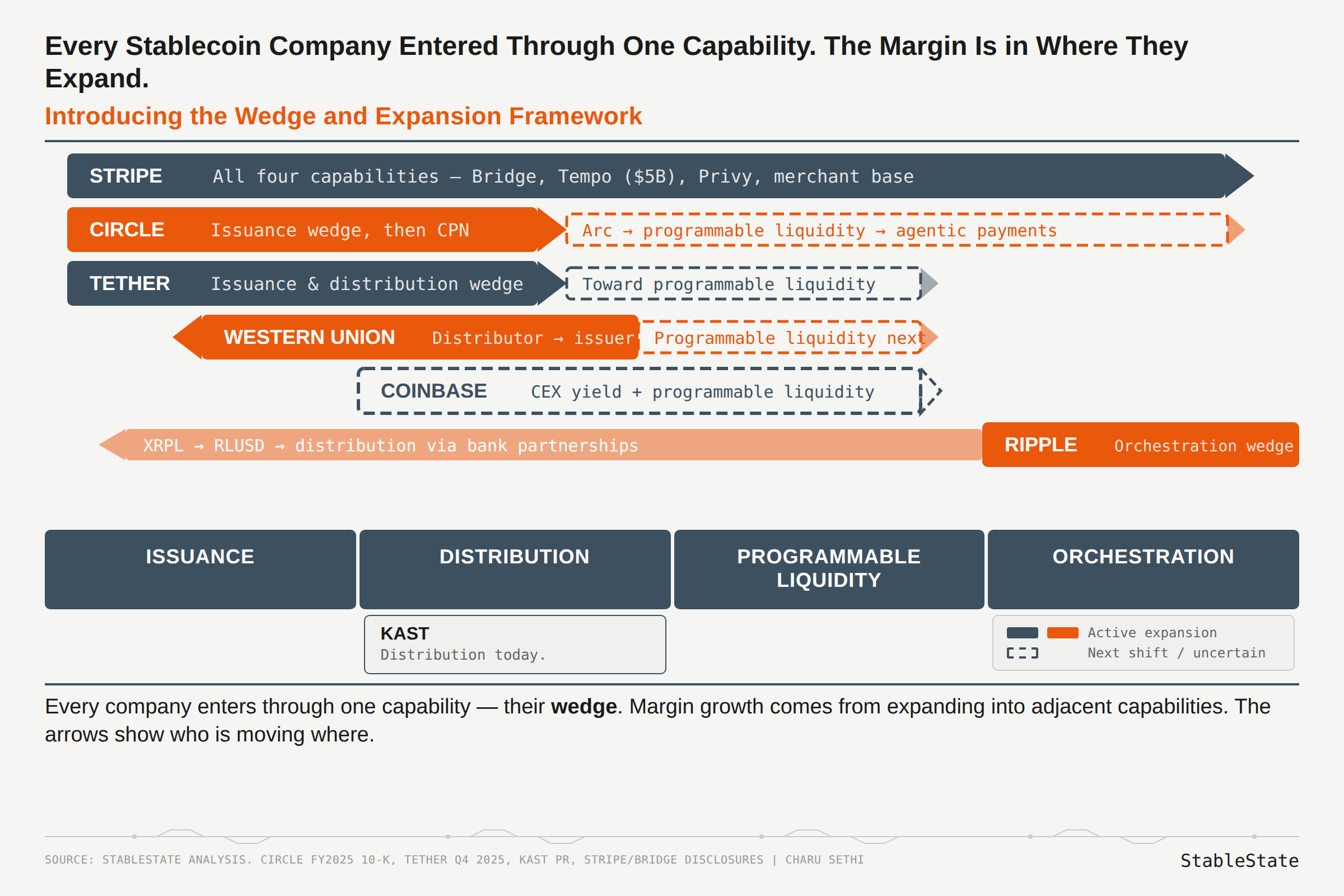
Static layer maps are useful for understanding what exists in the stack. They are not useful for understanding how companies actually go to market. What matters is where a company enters the market (its wedge) and where it is expanding, which is where the GTM changes, breaks, and has to be rebuilt.
Stablecoin GTM: The Wedge and Expansion Framework
The Wedge and Expansion Framework: Every stablecoin infrastructure company entered the market through one capability and is now expanding into adjacent ones. The hard part is not the entry. It is the transition, where the buyer and the sales cycles change.
1. From Issuance to Distribution: How Circle and Tether Are Rebuilding GTM
Circle and Tether both started by creating the asset. Now they are racing to control how it moves.
Circle’s FY2025: $2.7 billion in total revenue. Q4 distribution costs hit $461 million, up 52% year-over-year, mostly payments to Coinbase and Binance for USDC placement and holdings growth. For every dollar Circle earns, roughly 60 cents goes to someone else. That is the economic pressure driving Circle’s expansion: CPN onboarded 55 financial institutions in its first months, with 500+ in the pipeline. Arc is targeting mainnet this year. Circle is building its own distribution infrastructure to recapture the margin it currently pays out. (I covered Circle’s institutional stack in detail here.)
Tether took the opposite expansion path. Instead of institutional network effects, it built grassroots distribution in markets where traditional banking does not reach. Sub-Saharan Africa saw $22 billion in stablecoin transactions in 2023-2024 per Chainalysis, with USDT dominant. Tether invested in Kotani Pay (Kenya-based fiat rails) and HoneyCoin (Africa-wide USDT payments). (I compared Ripple’s institutional stack against Tether’s distribution network here.)
The GTM shift: When an issuer starts building distribution, the buyer changes. Circle’s CPN team is now also selling to compliance officers and treasury heads at financial institutions. Tether’s Africa expansion requires local payment rail integration, licensing partnerships, and corridor-specific positioning. Neither looks like an issuance GTM anymore.
2. From Distribution to Issuance: KAST, Western Union, and Coinbase’s Structural Tension
KAST is a distribution play today: corridor-by-corridor acquisition, FX conversion, interchange on stablecoin-funded card spend. Western Union announced USDPT on Solana with Anchorage Digital custody, connecting to 360,000+ cash pickup locations via Crossmint’s wallet APIs, targeting H1 2026 launch. A 175-year-old distributor decided to own its own stablecoin because it wants to capture the economics it was paying to someone else.
Coinbase generated $1.35 billion in stablecoin revenue in 2025 (19% of total revenue), mostly from a 50/50 revenue share with Circle on interest earned on USDC reserves. Average USDC on-platform hit $17.8 billion in Q4, an all-time high.
Here is the structural tension. The GENIUS Act prohibits issuers from paying yield. The CLARITY Act negotiations could extend that ban to exchanges. Armstrong told investors on the Q4 call: “It would actually make us more profitable because we would just continue to receive the economics from Circle. Today, we pass majority of that along to the customer.” But the 50/50 split dates to the Centre Consortium agreement from 2018, renegotiable with six months notice. If a yield ban removes Coinbase’s ability to attract deposits through rewards, Circle’s incentive to maintain a 50/50 split weakens. More margin today, potentially less leverage tomorrow.
The GTM shift: If you cannot pay users to hold stablecoins, you need a different acquisition strategy. Card programs, embedded finance, corridor-specific payment products. The companies building those alternatives now will own distribution when the rules change.
3. Infrastructure to Full Stack: Stripe’s Tempo and the Neutrality Problem
Stripe acquired Bridge for $1.1 billion (issuance), built Tempo with Paradigm ($500M raised, $5B valuation, Visa/Mastercard/UBS/Shopify/Nubank on testnet, 100K+ TPS), acquired Privy (wallet infrastructure), and already has the merchant base. Klarna plans to launch KlarnaUSD on Tempo through Bridge’s Open Issuance. Bridge’s transaction volume quadrupled in 2025. Visa and Bridge expanded stablecoin-linked cards to 18 countries, 100+ planned by year-end.
Stripe is operating across all four capabilities simultaneously. But Catalini flagged the tension: “If you are another big payment service provider, would you want to build on Stripe’s Tempo? Probably not.” Circle is building Arc. Having spent five years in web3 and Polkadot ecosystem as CMO at Unique Network, I have seen this dynamic play out before: platforms that control the full stack may eventually force the partners they need most to build alternatives. The best ecosystem GTM balances platform power with genuine neutrality, and that balance is not easy to achieve.
The GTM shift: When you control the full stack, your GTM is platform economics. Every partner that builds on your rails deepens your moat. But your biggest potential partners can become your competitors. The neutrality question is not a technology problem. It is a GTM problem.
4. Orchestration GTM: Ripple, JPMorgan, and Why the Token Is Never the Pitch
Ripple Payments sells cross-border settlement to banks and FIs. RLUSD is a feature of that sale, not the product. JPMorgan Kinexys uses tokenized deposits for enterprise treasury operations. Circle settling $68 million in internal transfers via USDC in under 30 minutes, compressing 90% of transfer pricing settlements into a single day, is the kind of proof point that moves pipeline in this segment.
I spent eight years at IBM running demand generation and ABM for financial services across APAC: building account-level business cases for ASEAN banks by mapping NPL ratios, cost-income trends, and branch footprints against regulatory shifts. Having sat in those account planning workshops, built relationship maps using Revenue Storm frameworks to identify allies and detractors on buying committees, and constructed the compelling reasons-to-act that get a bank CFO to commit budget, I know this sales cycle looks nothing like developer adoption. It runs 6-12 months, requires jurisdictional regulatory navigation, and the champion is never the person who signs. The token is never the pitch. The operational efficiency gain is.
The GTM shift: Orchestration companies issue tokens not as a product expansion but as a sales tool. Ripple’s RLUSD makes the Ripple Payments conversation stickier. Circle’s $68M internal settlement is a case study, not a product launch.
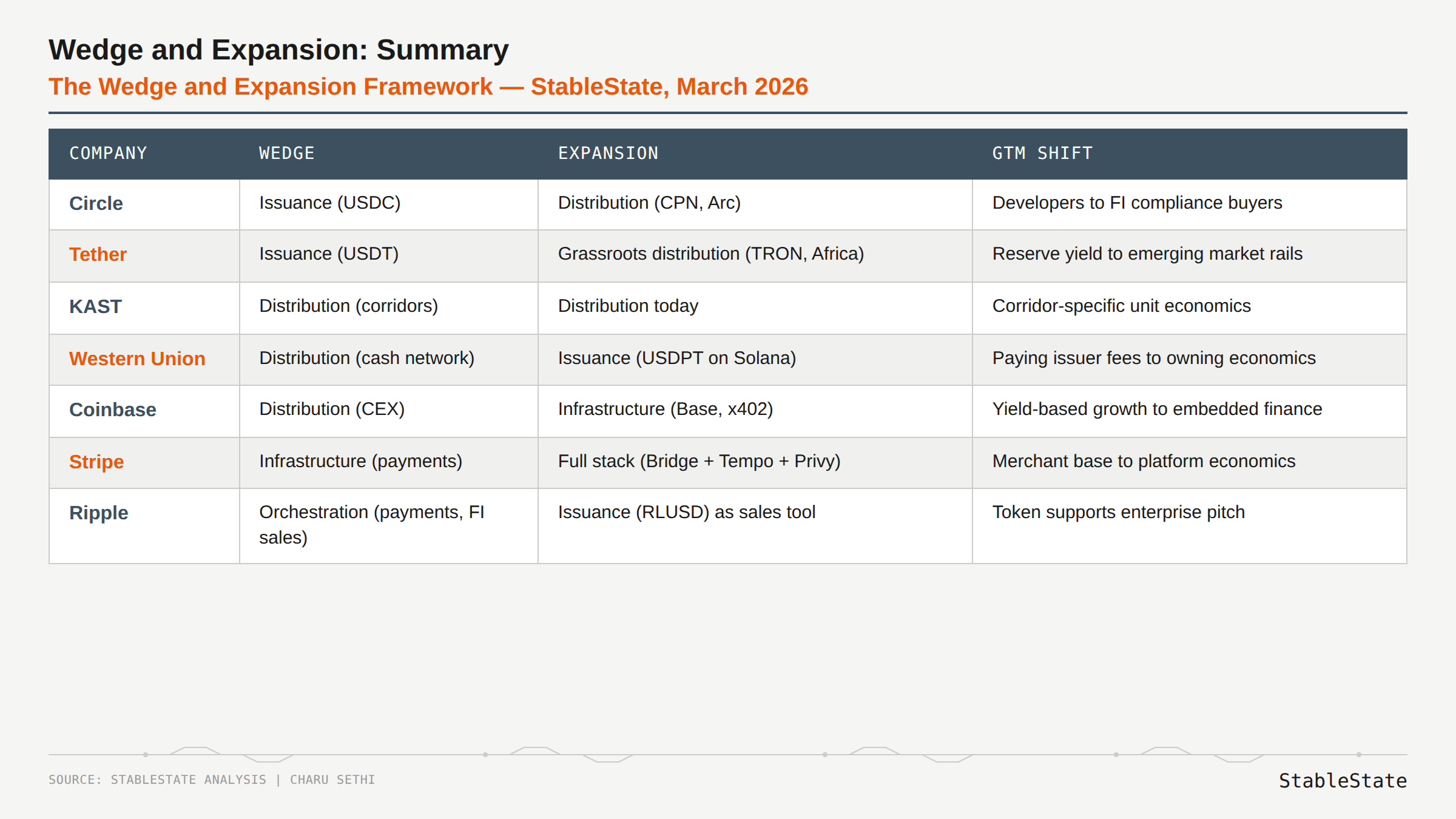
Wedge and Expansion: Summary
The Wedge and Expansion framework maps how stablecoin companies enter through one capability and grow margins by expanding into adjacent ones.
Where Stablecoin GTM Breaks: The Transition Problem
The wedge is not the hard part. The hard part is the transition: the moment an issuer starts selling to institutional buyers instead of developers, or a distributor launches its own stablecoin, or an infrastructure company tries to recruit partners who are also competitors. At each transition, the buyer changes, the sales cycle changes, and the team that built the wedge is often not the right skill set for the expansion.
Regulation accelerates these transitions. The OCC’s GENIUS Act NPRM (comment period closes May 1) and the HKMA’s first stablecoin licenses (expected as early as March 24, HSBC and Standard Chartered in the first batch) are both reshaping who can do what. Here in Singapore, the pre-positioning has been visible for months. MAS’s Major Payment Institution license framework already governs companies like Ripple, StraitsX, XREX, and Bitcheck, and every stablecoin infrastructure company serving APAC institutional buyers has been mapping compliance against both frameworks simultaneously.
Open FAQs for Stablecoin GTM Leaders
The execution of GTM at each stage of expansion is more nuanced than any framework captures in 2,000 words. The companies doing this well are building playbooks in real time.
Some questions worth sitting with: Where did your company enter the market, and where is it expanding? Is your GTM team built for the wedge or for the expansion, and are those the same motion? If the yield ban passes, have you stress-tested your acquisition strategy without rewards? And the question every multi-capability company eventually faces: are you competing with your own partners, and do they know it?
What is stablecoin distribution economics? Distribution economics describes how revenue flows through the stablecoin stack. Issuers like Circle earn reserve income but pay roughly 60% to distribution partners (Coinbase, Binance) who control user access. As issuance commoditizes, the companies that control distribution capture durable margin.
Why is Circle building CPN? Circle pays $461 million per quarter in distribution costs. CPN is its move to build direct institutional distribution: 55 financial institutions enrolled, $5.7 billion annualized TPV. The goal is to recapture the margin it currently pays to third parties.
How does the GENIUS Act yield ban affect stablecoin GTM? The GENIUS Act bars issuers from paying yield. If the CLARITY Act extends that to exchanges like Coinbase, the primary growth lever for USDC distribution disappears. Companies will need new acquisition strategies: card programs, embedded finance, corridor-specific products.
Related StableState Analysis
- Stablecoin Payment Infrastructure 2026, Part 1: What CFOs Need to Know About Arc, Tempo and the Last-Mile Problem
- Stablecoin Payment Infrastructure 2026, Part 2: Ripple’s Institutional Stack vs Tether’s $187B Global Network
- White-Label Stablecoins and the Unbundling of Correspondent Banking: Where Does Margin Migrate?
- How SMEs Actually Monetize Stablecoins: Four Revenue Layers Beyond Payments
Charu Sethi writes StableState, an intelligence brief on stablecoin infrastructure for institutional audiences. She spent eight years leading demand generation,ABM and enablement at IBM Financial Services across APAC, building account-level business cases for banks across ASEAN. Previously CMO at Unique Network (Polkadot ecosystem), where she scaled the platform to 1M+ wallets and led $11M in token sales. StableState covers topics like the margin migration from issuance to distribution, regulatory shifts, (OCC GENIUS Act, HKMA licensing), and GTM & Marketing strategy for stablecoin infrastructure companies. LinkedIn | X / Twitter
Data Sources and Primary References
All key data points are linked inline at first reference. Full reference list below.
KAST Fundraise and Metrics
- KAST $80M Series A at $600M valuation, 1M users, $5B annualized volume, $100M ARR target, 250+ hires (PR Newswire, March 9, 2026): prnewswire.com
- KAST leadership based in Singapore, incorporated Seychelles (PitchBook; Electronic Payments International via Yahoo Finance, March 2026): pitchbook.com, finance.yahoo.com
- QED Sandeep Patil: “Fintech is a trust business disguised as software” (KAST press release): prnewswire.com
Circle Financial Results
- Circle FY2025: $2.7B revenue, Q4 distribution costs $461M (+52% YoY), RLDC margin 40.1% (Circle Q4 2025 earnings, February 25, 2026): circle.com
- CPN: 55 FIs enrolled, $5.7B annualized TPV, 68% sequential growth (Circle Q4 2025 earnings call): fool.com
- USYC: $1.5B at year-end (Circle Q4 2025 earnings): circle.com
- Circle $68M internal USDC treasury settlement (CoinDesk, March 7, 2026): coindesk.com
Coinbase Stablecoin Revenue
- Coinbase $1.35B stablecoin revenue in 2025, Q4 $364M, USDC balances $17.8B all-time high (GNCrypto, February 2026): gncrypto.news
- Bloomberg Intelligence: Coinbase stablecoin revenue could grow 2-7x (Cointelegraph, February 2026): cointelegraph.com
- Armstrong Q4 earnings call: yield ban “would actually make us more profitable” (Stocktwits, February 2026): stocktwits.com
- Centre Consortium 50/50 revenue share, renegotiable with six months notice (Stablecoin Insider, December 2025): stablecoininsider.org
Tether Distribution and Users
- Tether: 534M users, 139M on-chain wallets, $187.3B market cap (Tether Q4 2025 Market Report): tether.io
- 60%+ of USDT supply on TRON, 75% of stablecoin saver wallets (Tether Q4 2025 Report): tether.io
- Tether investment in Kotani Pay, Kenya (Brave New Coin, October 2025): bravenewcoin.com
- Africa stablecoin transactions $22B 2023-2024 (Chainalysis): bravenewcoin.com
Stripe, Bridge, Tempo
- Bridge transaction volume quadrupled in 2025 (Stripe annual letter via CoinDesk, February 24, 2026): coindesk.com
- Tempo: $500M raised at $5B valuation, design partners (The Block, October 2025): theblock.co
- KlarnaUSD on Tempo via Open Issuance (The Block, November 2025): theblock.co
- Visa and Bridge stablecoin-linked cards, 18 countries (Visa press release, March 3, 2026): usa.visa.com
- Catalini on Tempo neutrality (CoinDesk, February 28, 2026): coindesk.com
Western Union USDPT
- USDPT on Solana, Anchorage Digital custody, 360,000+ locations, H1 2026 (Western Union press release, October 2025): businesswire.com
Regulation
- OCC GENIUS Act NPRM (February 25, 2026): occ.gov
- HKMA: HSBC, Standard Chartered expected first batch, March 24 (Bloomberg via Blockhead, March 13, 2026): blockhead.co
Stablecoin Market Data
- Christian Catalini on distribution and commoditization (CoinDesk, February 28, 2026): coindesk.com
- $1.8T stablecoin volume February 2026 (Allium via Tron Weekly): tronweekly.com
- McKinsey: only 1% of stablecoin volume is real-world payments (CoinDesk via KAST coverage): coindesk.com
- Citi: $1.9T-$4T stablecoin market projection (CoinDesk, February 2026): coindesk.com