Korea Is Not Building Stablecoins To Fix Payments
Six months from absent to task four on the won internationalisation roadmap Stable State Sep 24, 2026
In most markets you can read the policy outward from the stablecoin regime. Hong Kong passed an ordinance, took applications, granted licences, and the Hong Kong dollar was not the subject. The United States legislated after a market already existed.
Korea inverts it. The stablecoin is not the policy. It is a late arrival to a currency programme that has been running since 2008.
What the won file actually is
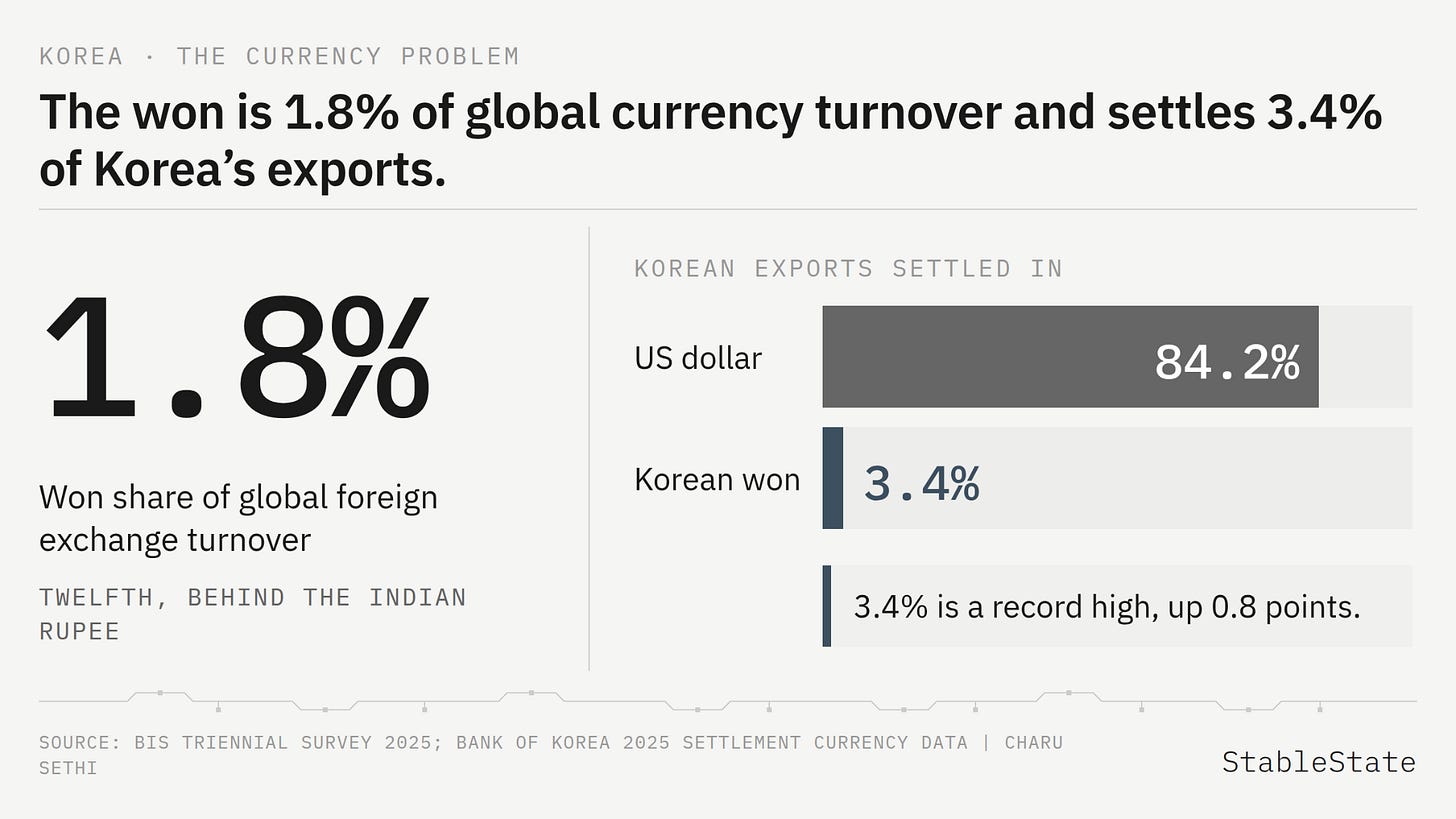
The won is 1.8% of global foreign exchange turnover. Twelfth, behind the Indian rupee. And 84.2% of Korean exports settle in US dollars, against 3.4% in won.
Korea opened its capital account in stages, phasing the 1999 Foreign Exchange Transactions Act across April 1999 and January 2001, most of it after the crisis and under the programme agreed with the International Monetary Fund. What it held back was the won itself.
Second Vice Minister Huh Jang, in July 2026, called won internationalisation the core task for “fundamentally reforming the foundation of the foreign exchange policy that has been maintained since the 1997 foreign exchange crisis”. A policy kept for twenty-nine years, now progressing deliberately and in stages.
The standard case for the restriction, which the Korea Capital Market Institute reports as an argument in circulation rather than its own, is that offshore won trading makes speculative attack easier and monetary policy harder.
The priority changed. Korea wants the inbound flows that come with developed market status, and those flows need a currency foreigners can hold and trade without asking first.
MSCI put Korea on its Developed Market watchlist in 2008 and named three obstacles the following year: won convertibility, a rigid investor identification system, and restrictive terms on the use of exchange data. In 2013 it noted there had been “no new developments over the course of the past year”. In 2014 Korea came off the list.
Changing who wants to hold your currency takes something else entirely.
(MSCI is a US index provider whose Emerging and Developed labels steer where a great deal of passive equity money goes, and it still rates Korea Emerging. FTSE Russell, part of the London Stock Exchange Group, runs the main global benchmark for government bonds and already rates Korean equities Developed.)
The reform that worked
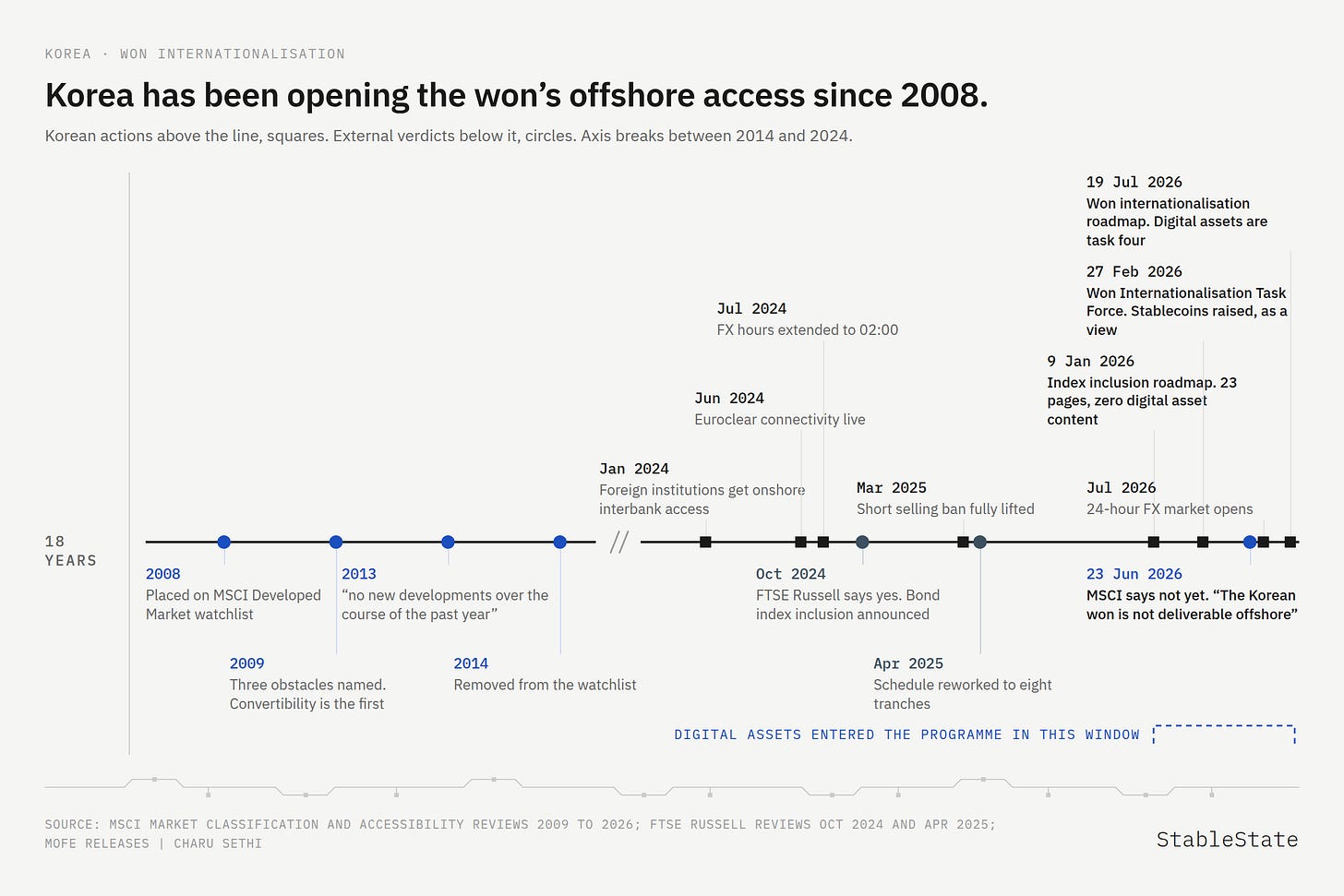
Foreign institutions got access to the onshore interbank market in January. Euroclear connectivity went live in June. Trading hours extended to 02:00 on 1 July. In October FTSE Russell announced World Government Bond Index inclusion and named two of those reforms as the reason: the depository connectivity and third-party foreign exchange in won. The short selling ban lifted fully on 31 March 2025.
FTSE Russell later reworked the schedule, from quarterly into eight monthly tranches running April to November 2026. Korea ends at 1.75% of the index across 65 bonds.
A different examiner, a different index, and this one said yes.
The Korea Capital Market Institute measured the first year of the extension. Daily spot volume rose 44.6% against the 2019 to 2023 average.
The fear was that longer hours would bring worse volatility. The data says otherwise, and that was the objection that could have stopped the reform.
Then, on 23 June 2026, MSCI said not yet again, and the clause nobody quotes is the one that matters.
“The Korean won is not deliverable offshore. Even more concerning, onshore liquidity during the extended FX trading hours remains largely insufficient to support tight execution at standards comparable to those observed in developed markets.”
Korea opened those extended hours in July 2024. Two years later the examiner called them quiet. On 7 July 2026 Korea extended them to twenty-four, a move announced in January and not a response to anything.
Choi Ji-woon at the Capital Market Institute had warned five weeks before the verdict that the measures might not yet deliver full convertibility. He was right.
The market is open. The volume has not followed yet. Those are different problems, and only one of them responds longer trading hours.
When digital assets joined the file
On 9 January 2026 the joint-ministry roadmap for index inclusion set out eight initiative areas across 23 pages. Occurrences of digital assets, virtual assets, stablecoins, coin, blockchain, token, crypto or central bank digital currency across those 23 pages: zero.
Seven weeks later the Ministry launched a Won Internationalisation Task Force, and the readout says “the view was raised that stablecoins, whose institutional adoption is under discussion globally, could be one alternative for expanding won usage.“ A view raised at a meeting. But the contact list on that release had quietly acquired the Financial Services Commission’s Virtual Asset Division and the supervisor’s Virtual Asset Supervision Department, neither on the January list.
By 19 July, digital asset payment infrastructure is task four of the won internationalisation roadmap, alongside a government bond tokenisation pilot for 2027 and membership of Project Agorá.
Six months from zero mentions to a numbered task.
The currency programme had an eighteen-year problem and no instrument for it, somebody noticed in February that an instrument had appeared, and the contact list changed before the policy did.
What follows the discovery is coherent, which is a smaller claim.
Governor Shin Hyun-song, at his first briefing in April, put it as a precondition: only when the offshore settlement system is properly built does it become the cornerstone for raising the won’s international standing. Korean coverage reached for the obvious comparison, the Federal Reserve’s dollar settlement network. At Sintra in July he ran bond tokenisation into the same objective, letting non-residents hold more won assets and trade them more easily.
The dollar’s advantage is not that anyone loves dollars. It is that the pipes exist everywhere and the water is always running. Korea is building pipes.
What is permitted, and what is waiting
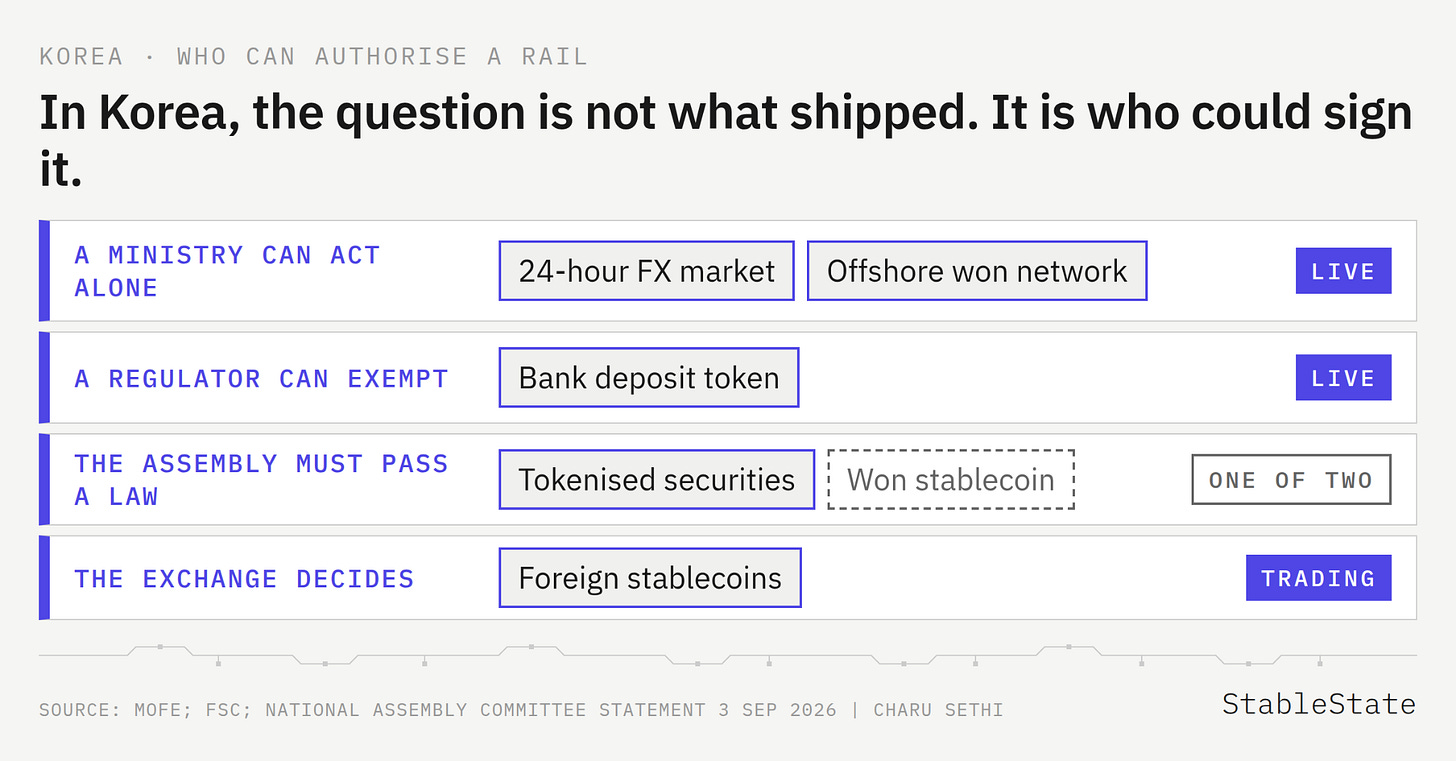
I sorted the rails by what it took to authorise them - And I saw a pattern..
The 24-hour market came by ministerial action. The offshore won settlement network by ministerial notice in August, with a pilot the following month.
The deposit token by a regulatory sandbox designation on 15 July, indefinite, across nine banks who paid for it themselves: 81,000 wallets, 114,880 transactions, doing retail payments, government subsidies and electric vehicle charging vouchers.
All live.
Tokenised securities needed a law. It passed in January 2026 and the market opens in February 2027, with one thing unresolved. The securities move onto a distributed ledger. The money does not. Cash settles where it always has, through the depository, and on-chain cash is a later phase with no date on it, because that needs the stablecoin law too.
So the new market has to prove itself while running on the old market’s money. Sim Su-bin at Kiwoom Securities put it simply: while both run side by side, it will be hard to show the new one is cheaper or faster.
The asset leg is solved and dated. The money leg is not yet.
The won stablecoin needs a law and does not have one yet.
Around thirty virtual asset bills now sit in the National Policy Committee. About nine carry stablecoin provisions and eight are full frameworks, differing on who may issue, what backs the coin, where reserves sit and who supervises the result. The central bank wants banks to hold 51% or more of any issuer.
None has been processed. On 3 September the committee chair said the government’s own bill had still not arrived.
So Korea is holding position, and nine banks built and paid for a deposit token network while holding it.
Nobody is waiting to find out whether it happens. They are waiting to find out in what order.
The rail that exchanges can approve
Sorting by authorising instruments misses one category that has volume.
Korean law has no stablecoin. A dollar or a yen token is a virtual asset like any other, and no regulator approves a listing. The exchange decides, under industry rules that give a foreign token a shortcut if it already trades on a regulated market abroad.
Which sets the limit on what a Korean buyer can do. Buy, hold, sell. Not redeem, because Circle and Tether both restrict that to verified institutional customers, and the yen token’s redemption runs through a Japanese identity card and a Japanese bank account.
The only exit is selling to another Korean.
On 17 September Upbit listed that yen token, the first yen stablecoin in Korea. It opened at ₩12 against a yen worth about ₩8.80. An hour later it printed ₩37.60.
Four times the value of the thing it represents.
Supply could not arrive: Upbit delayed the open twice for want of inventory, and the issuer, who said he had not known about the listing, suspended new issuance that night. Buyers could bid. Nobody could mint, nobody could redeem. By the next evening it was back to ₩9.37.
A market can be open and still price badly when the path out of it is blocked. MSCI named that mechanism in June, on a different market with different participants. Korea has now watched a version of it on its own exchange.
Whatever a won stablecoin turns out to be for, the redemption path has to exist before the token does. That path sits in the bill that has not passed.
Does the merchant payments case hold
The domestic argument is that merchants save on card fees. The published number was .₩5.15tn a year.
It is one cell out of twelve. The National Assembly Budget Office published a grid on 8 September built on ₩1,225.1tn of 2025 card spending. ₩5.15tn is the most optimistic corner. Its own preferred figure is ₩1.2tn.
[EXHIBIT 4: The Budget Office published twelve scenarios. The coverage printed one]
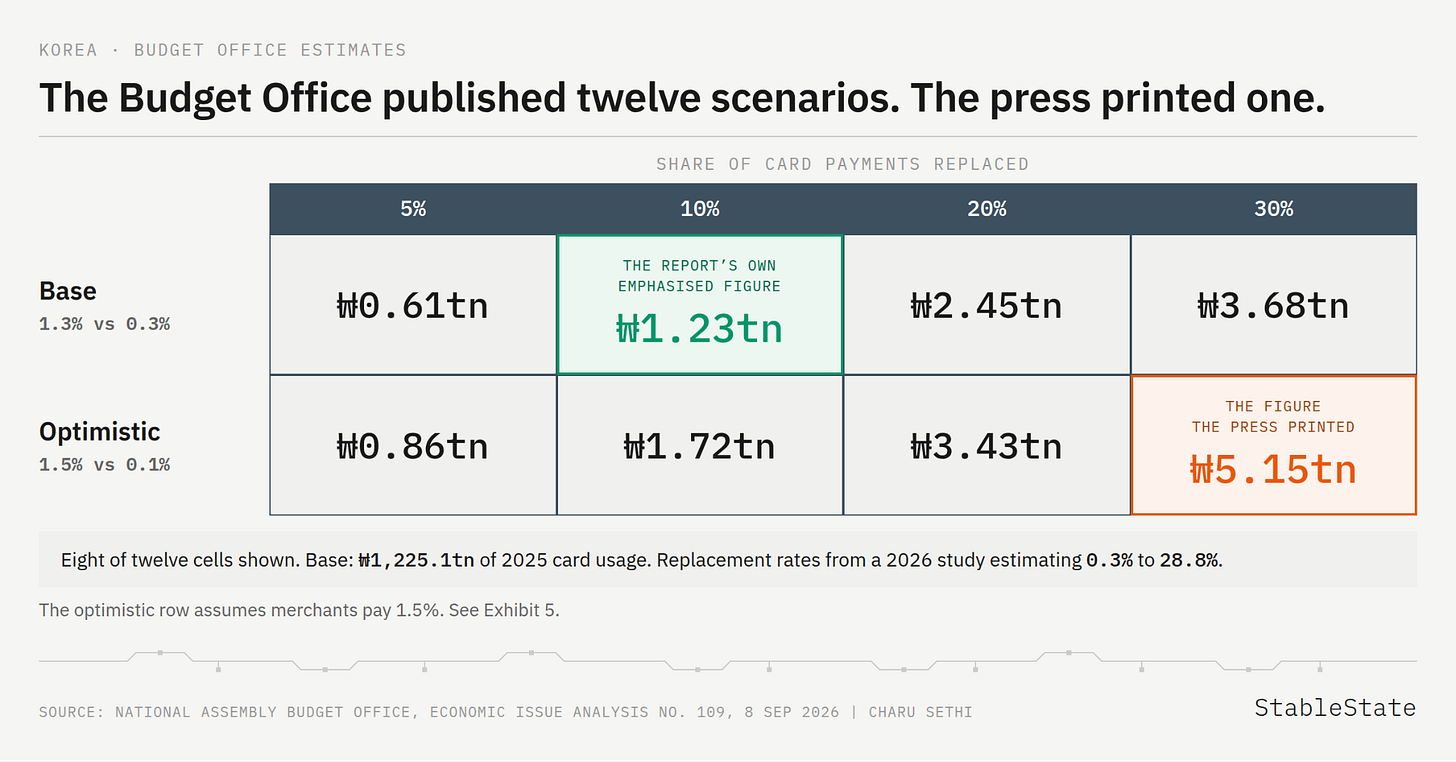
The replacement rate it uses ranges from 0.3% to 28.8%, wide enough to produce any answer you want.
The fees structure is more layered to understand.
That ₩5.15tn assumes Korean merchants pay 1.5% on cards. Almost none do. Korea has capped small merchant fees since 2012, and 95.7% of merchants now pay between 0.40% and 1.45%. The smallest shops pay 0.40% on credit, 0.15% on debit.
The Budget Office assumes a stablecoin would charge 0.3%.
So a corner shop saves a tenth of a point. On debit it would pay more, not less.
The saving is real. It belongs to the 4.3% outside the cap, which means the large merchants.
The merchant fee case is strongest exactly where the small business story is weakest.
Card fees are one of the most reliable issues in Korean politics, pledged in both the 2017 and 2025 presidential races. What surprised me is that the stablecoin sponsors are not using it. Their framing is currency, not commerce: payment sovereignty, the settlement market being colonised, financial stability. The small business federation, loud on card fees for a decade, has said nothing about won stablecoins.
The number came from the Assembly’s research office, after every bill was filed.
And the sentence that should have been the headline sits just below. The report concedes a won stablecoin could build a won-denominated trading base at home, then says:
“However, it is difficult to regard this immediately as a won internationalisation effect, because overseas demand for won assets, capital transaction regulation, foreign exchange market liquidity and hedging instruments must all support it together.”
Four conditions, joined by “all”.
Korea’s own fiscal watchdog separating the domestic payments story from the international one, and listing what the second would take. Buried in 156 pages of Korean, which is presumably why the number became popular and the sentence did not.
One footnote. In August an offshore service briefly resold vouchers for ninety Korean brands, Olive Young and Daiso among them, for an offshore won token. It lasted five days before the regulator called it a laundering risk.
The private sector has drawn the same conclusion. Four Pillars, whose August report is the best bank-side work on Korean tokenised money, tells banks to build deposit token rails now and be ready to issue when the law passes. Sensible, and buildable next quarter. It never mentions the index, internationalisation or foreign exchange. (Disclosure: Four Pillars is backed by Kakao Ventures, Hashed and BASS Investment.)
Right call for a company that has to ship this year. Different question from the one Korea’s currency programme is asking.
FAQ
A reference section, current as of 21 September 2026.
Is a won stablecoin legal in South Korea? No. There is no Korean law authorising won stablecoin issuance. Around thirty virtual asset bills sit before the National Assembly’s National Policy Committee, about nine carrying stablecoin provisions and eight of those full frameworks. None has been processed, and as of 3 September 2026 the government’s own bill had not been submitted.
Why is Korea pursuing stablecoins? The driver is currency policy, not payments. Digital asset payment infrastructure is task four of the won internationalisation roadmap published on 19 July 2026. The underlying programme dates to 2008, when MSCI placed Korea on its Developed Market watchlist. Digital assets entered that programme in the first half of 2026, having been absent from the January 2026 index inclusion roadmap entirely.
Can foreign stablecoins be listed on Korean exchanges? Yes. A dollar or yen stablecoin is classified as a virtual asset under the Virtual Asset User Protection Act, with no separate stablecoin category in Korean law. No regulator approves individual listings; exchanges decide under DAXA’s self-regulatory standards, which give partial exemption to tokens already trading on qualified foreign markets. USDT, USDC, RLUSD, PYUSD, EURC and JPYC are all listed domestically.
Can Korean retail investors redeem stablecoins with the issuer? No. Circle restricts redemption to institutional Circle Mint account holders. Tether requires a verified customer and a bank account in the holder’s own name. Ripple’s direct customers are enterprises. JPYC redemption requires Japanese identity verification and a Japanese bank account. Korean retail holders can only sell on an exchange.
How much would a won stablecoin save Korean merchants? The National Assembly Budget Office’s 8 September 2026 report gives a range, not a figure: ₩370bn to ₩5.15tn a year across twelve scenarios. Its own emphasised case is ₩1.2tn. The widely reported ₩5.15tn assumes both the most optimistic fee spread and 30% card replacement. It also assumes merchants pay 1.5%, while 95.7% of Korean merchants are on preferential rates of 0.40% to 1.45%.
Has MSCI upgraded Korea to Developed Market status? No. On 23 June 2026 MSCI again declined, citing that the won is not deliverable offshore and that onshore liquidity during extended foreign exchange hours “remains largely insufficient to support tight execution”. FTSE Russell, a different index provider, did include Korea in its World Government Bond Index, phasing in over eight monthly tranches from April to November 2026.
When does Korea’s tokenised securities market open? February 2027. The enabling law passed in January 2026. Under the Financial Services Commission’s 4 September 2026 policy direction, the first phase settles cash through the existing depository system rather than on-chain. On-chain settlement is a later, undated phase conditioned on stablecoin legislation.
Does Korea have a deposit token? Yes, in pilot. The Bank of Korea’s deposit token runs under a regulatory sandbox designation granted 15 July 2026, indefinite in term, across nine banks, with 81,000 wallets and 114,880 transactions recorded. It needed no new legislation because the customer’s claim remains a bank deposit throughout.
Sources
Index providers
- MSCI, 2026 Market Classification Review, 23 June 2026, for the decision and the reasons given
- MSCI, 2026 Global Market Accessibility Review, June 2026, for the country detail, and the market classification hub for the earlier reviews
- FTSE Russell, September 2024 country classification review for World Government Bond Index inclusion, and the March 2026 fixed income results for the phase-in, the 1.75% weight and the 65 bonds
Currency and market data
- Bank for International Settlements, 2025 Triennial Central Bank Survey, FX detailed tables, final results June 2026, for the won’s share of global turnover
- Bank of Korea, 2025 settlement currency trade data, released 16 April 2026, for the 84.2% and 3.4% export figures
- Upbit, live price data, for the yen token’s listing day
Korean government
- Ministry of Economy and Finance, index inclusion roadmap, 9 January 2026
- Ministry of Economy and Finance, Won Internationalisation Task Force launch, 27 February 2026
- Ministry of Economy and Finance, won internationalisation roadmap, 19 July 2026, where digital asset payment infrastructure is task four
- Financial Services Commission, tokenised securities policy direction, 4 September 2026
- Financial Services Commission, 2026 card merchant fee rates, for the preferential bands and the 95.7%
- Financial Services Commission, short selling fully reinstated, 31 March 2025
- National Assembly Budget Office, Economic Issue Analysis No. 109, 8 September 2026, for the twelve-scenario grid and the four-condition passage
Research and industry
- Korea Capital Market Institute, Issue Report 26-11, 13 May 2026, on the extended foreign exchange trading hours
- DAXA, virtual asset trading support best practices, in force 19 July 2024, for how a foreign token gets listed
- Circle and Tether redemption terms
Reporting
- Seoul Economic Daily on the voucher service, 23 August and 13 September 2026
- edaily, committee chair on the missing government bill, 3 September 2026