How SMEs Actually Monetize Stablecoins: Four Revenue Layers Beyond Payments
Why payment volume is a trap, how regulation determines which revenue layers are accessible, and what CFOs should watch in stablecoin infrastructure for 2026.
TLDR: E-wallets like MoMo and GoPay prove that payment volume alone doesn't monetize; credit is the business, and regulation determines who can build it. Stablecoin rails unlock four revenue layers structurally blocked under fiat e-wallet frameworks: yield on idle balances, programmable trade escrow, receivables-backed credit, and treasury orchestration. African SMEs already access all four because they hold stablecoins as working capital; ASEAN SMEs are locked at layer one. The GENIUS Act's yield prohibition and the OCC's February 2026 proposed rules may paradoxically accelerate DeFi treasury adoption. Three bets for CFOs: tokenized receivables (not tokenized Treasuries) are the emerging market breakthrough; compliance infrastructure is competitive moat, not cost center; and U.S. regulation designed to protect bank deposits could become the largest catalyst for programmable liquidity.
The Payment Trap
MoMo — Vietnam’s largest e-wallet with approximately 40 million users — generated VND 8.5 trillion (~$350 million) in revenue in 2022, its last publicly reported year, while still recording nearly VND 1.15 trillion in net losses. Revenue comes overwhelmingly from transaction fees and cashback commissions. Despite 17 years of operation and one of Southeast Asia’s densest mobile money networks, MoMo remains trapped in the payment layer — generating volume without building the relationship layers that turn payments into a profitable business.
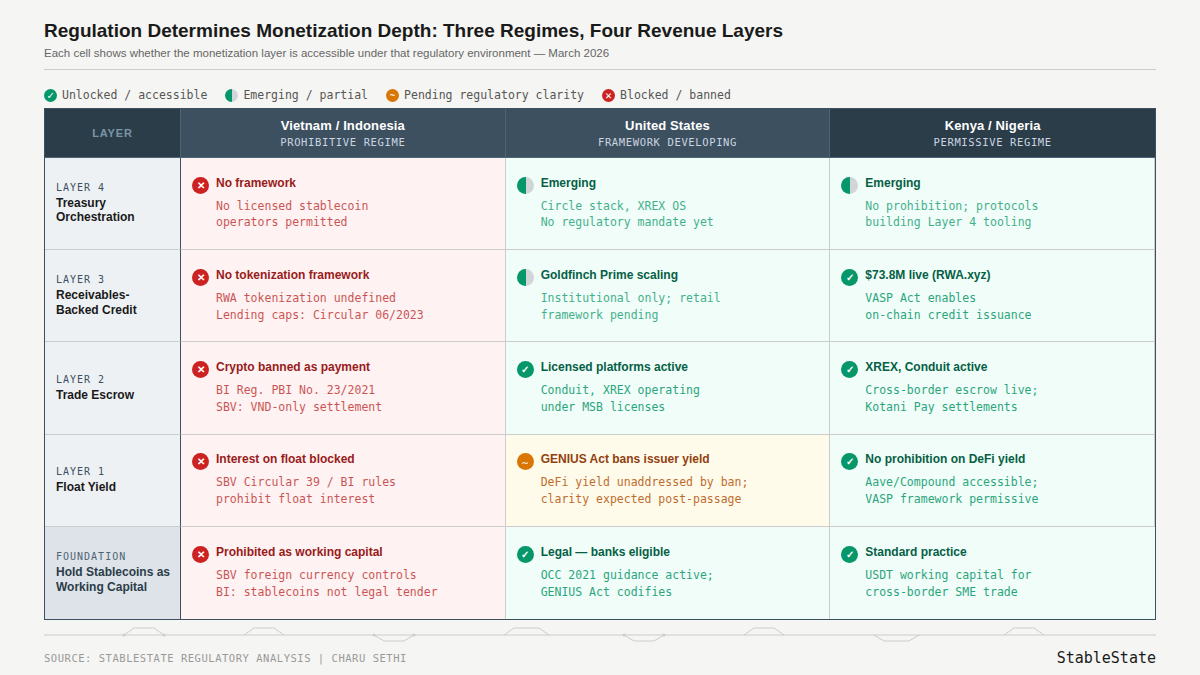
The regulatory architecture explains why. Vietnam’s State Bank (SBV) Circular 39/2014 prohibits e-wallets from paying interest on float — user balances are economically dead capital. Circular 06/2023 caps electronic loans at 100 million VND (roughly $4,000) for living purposes. The 2024 Law on Credit Institutions requires institutional separation between e-money operators and banking activities. Even MoMo’s partnership with TPBank cannot replicate what Indonesia’s GoTo Financial achieved: a seamless lending engine.
GoTo cracked it by finding the regulatory seam. Through its 22% stake in Bank Jago — a fully licensed commercial bank — GoTo built a structure where GoPay serves as the distribution front-end while Bank Jago originates loans on its balance sheet. No electronic channel cap applies. Result: lending revenue hit Rp 1.0 trillion in Q3 2025, representing 67% of the fintech segment’s Rp 1.5 trillion in net revenue (GoTo Q3 2025 earnings release). Consumer loans outstanding reached Rp 7.6 trillion (+76% YoY). Adjusted EBITDA turned positive at Rp 136 billion. Meanwhile, ASEAN fintech funding fell 36% to $835 million in the first nine months of 2025, deal count collapsing 60% to 53 — the lowest since 2016. Investors want monetization, not volume.
The universal lesson: payment rails are loss-leaders. Credit is the business. But most emerging market regulatory frameworks block the leap from payment volume to lending relationships. Stablecoins change the monetization physics — not because the payment is cheaper, but because holding stablecoins opens revenue layers that fiat regulatory architecture blocks.
Why Africa Skipped the Wallet Wars
African SMEs didn’t adopt stablecoins because a well-funded startup offered them incentives — they adopted them because holding local currency had become a liability. Nigeria processed $22 billion in stablecoin transactions in 2023-24 because the naira lost roughly 80% of its value against the dollar since 2020. Kenya’s VASP Act (October 2025) formalized stablecoin use after massive adoption was already underway. M-Pesa’s 33 billion annual transactions created the mobile money habit; stablecoin bridges — Kotani Pay via USSD/SMS, MiniPay with 12.6 million wallets — plugged into existing behavior without requiring new user acquisition.
The structural difference that matters: African SMEs hold USDT as working capital. No prohibition on business stablecoin balances exists — unlike Vietnam and Indonesia, where regulations explicitly block crypto as a means of payment. Kenya leads globally in tokenized private credit ($73.8 million per RWA.xyz), meaning regulators implicitly accept on-chain receivables as valid financial instruments.
Tether’s investment strategy validates the distribution-first thesis: $18.75 million into XREX for B2B cross-border trade infrastructure, investments in Kotani Pay and HoneyCoin for on-ramp/off-ramp infrastructure, and most recently $200 million into Whop — the 18.4-million-user creator marketplace — to embed USDT/USA₮ payments across Latin America, Europe, and Asia-Pacific. Each investment embeds stablecoins into existing economic activity rather than building new acquisition funnels.
Because these SMEs already hold stablecoins as operating capital, the question shifts from “how to adopt?” to “how to monetize what you’re already holding?” Four layers.
Four Monetization Layers That Stablecoin Rails Unlock
These aren’t theoretical. Each layer represents a concrete P&L line item. They stack progressively — you can capture Layer 1 without touching Layer 4. The common thread: each exists because stablecoins are programmable bearer instruments that sit outside the regulatory constraints governing traditional e-money and bank deposits.
Layer 1: Yield on Idle Balances — With a Critical Regulatory Caveat
An SME holding $50,000 in USDC can deploy idle working capital into tokenized Treasury vaults returning 3.75–5.3%, or structured DeFi positions at 8–12%. The on-chain equivalent of a corporate money market fund — 24/7, no minimum balance, no banking relationship required.
The caveat CFOs must understand: The U.S. GENIUS Act (signed July 2025) prohibits stablecoin issuers from paying yield on holdings — the statutory prohibition is narrowly on issuers. But the OCC’s proposed implementing rules — a 376-page document released February 25, 2026 and currently in a 60-day public comment period — extend the perimeter significantly: they create a rebuttable presumption that payments through affiliates or related third parties also violate the prohibition. This directly threatens arrangements like the Circle-Coinbase revenue-sharing model. The OCC NPRM was published just days before this article — the final rule outcome is actively contested, not merely uncertain.
But DeFi protocols and third-party treasury platforms currently operate outside this perimeter. The Senate Banking Committee’s January 12, 2026 RFIA discussion draft (building on the House CLARITY Act) carves out “activity-based rewards” — including liquidity provision, staking, and protocol participation — from the yield ban. This is literally the central unresolved issue stalling U.S. crypto market structure legislation. The rules are still being shaped. The strategic line to understand: issuer-paid yield (prohibited) versus protocol-earned yield (currently permitted). That distinction will determine how this layer evolves.
Building here: Ondo Finance (tokenized Treasuries, $1.6B TVL), Pendle (yield tokenization), Fireblocks ($6T stablecoin volume in 2025, institutional custody enabling DeFi access).
Layer 2: Programmable Trade Escrow — Replacing Letters of Credit
Cross-border trade between unfamiliar counterparties traditionally requires Letters of Credit: 1–3% of transaction value, weeks of processing, banking relationships many SMEs simply don’t have. Programmable stablecoin escrow replaces this. Buyer deposits USDT into a smart contract. Seller receives cryptographic proof of funds — verifiable, irrevocable, instant. Funds release on delivery confirmation or fulfillment of digitally signed contract terms.
The real value isn’t fee savings. It’s working capital velocity. If capital turns 6x annually instead of 4x because escrow settles in days rather than weeks, the compounding effect on revenue dwarfs the direct cost reduction. Critical question for any CFO evaluating this: does the platform offer legally enforceable digital contracts that your counterparty’s jurisdiction recognizes?
Building here: XREX BitCheck (programmable escrow with digitally signed legal terms — Tether portfolio company, MAS-licensed, FinCEN-registered), Conduit ($10B annualized TPV in Africa/LatAm import-export stablecoin settlement).
Layer 3: Receivables-Backed Credit — Your Invoices Become Collateral
An SME with a track record of stablecoin-settled transactions can tokenize outstanding invoices — on-chain assets serving as collateral for immediate liquidity. Instead of waiting 60–90 days for customer payment, pledge the tokenized receivable and receive 70–85% of invoice value immediately in stablecoins.
On-chain transaction history provides underwriting signals banks never had: payment velocity, counterparty diversity, settlement reliability across months of verifiable data. The global MSME finance gap reaches $5.7 trillion according to the IFC/World Bank’s March 2025 assessment — not a capital shortage, but an underwriting data problem. The honest constraint: FX risk is real. Borrowing in USDC while earning in Kenyan shillings or Vietnamese dong means depreciation directly inflates effective cost of capital.
Building here: Huma Finance ($8B+ processed, $50M Tala partnership bringing 13M users and $7B underwriting data on-chain — featured in Visa’s stablecoin lending report), Jia ($12M deployed Kenya/Philippines, <0.1% defaults, $200–$5K loans), Goldfinch Prime (pivoted to institutional private credit funds on-chain — the pivot itself signals that direct SME lending via DeFi is hard to scale without institutional backing).
Layer 4: Treasury Orchestration — The Operating System
Layers 1–3 are individual functions. Layer 4 connects them. A CFO defines policy — risk limits, liquidity thresholds, allocation bands — and an autonomous system executes across yield venues, escrow positions, and credit facilities simultaneously. Cash not needed this week flows to yield. Receivables from last month collateralize next month’s inventory purchase. Excess yield routes back when payroll is due.
This layer is the least mature but represents the deepest margin opportunity. Every action verifiable on-chain — critical for audit and compliance. The platforms building here are early-stage, but the architectural direction is clear: the CFO shouldn’t need to become a DeFi expert to access the full stablecoin stack.
Building here: XREX Payment Flow OS (2026 roadmap — embedding stablecoin settlement directly into corporate ERP systems), Circle’s horizontal infrastructure stack (CCTP V2 cross-chain transfer, Hashnote yield, x402 machine-to-machine payments).
Three Bets for CFOs
Bet 1: Tokenized receivables, not tokenized Treasuries, are the breakthrough for emerging market SMEs. BlackRock BUIDL and Ondo matter for institutions. But for the $5.7 trillion MSME finance gap, the ability to tokenize a Kenyan tea exporter’s invoices into on-chain collateral unlocks real credit access. Watch whether Tala + Huma’s $50 million facility proves this at scale — it combines 13 million users, $7 billion in underwriting data, and on-chain capital markets infrastructure in a single stack.
Bet 2: The compliance layer is the product. Every function in this stack depends on KYC, AML/CFT, and KYT infrastructure to be commercially viable. This isn’t a burden CFOs must solve alone — it’s embedded in the platforms. XREX holds MAS Major Payment Institution license, Taiwan VASP registration, and FinCEN MSB status, with AML/KYT screening built into every transaction flow. At the infrastructure layer, TRM Labs (valued at $1B, monitoring 50+ blockchains in real-time) and Chainalysis provide the blockchain intelligence that makes stablecoin compliance auditable and scalable. SMEs demonstrating clean compliance trails access better credit terms, lower escrow fees, and broader counterparty acceptance. Compliance infrastructure isn’t a cost center — it’s competitive moat.
Bet 3: The GENIUS Act yield prohibition may paradoxically accelerate DeFi treasury adoption. The OCC’s proposed rules are still in public comment — the final shape of U.S. stablecoin regulation is genuinely uncertain as of March 2026. But if the prohibition on centralized yield holds while DeFi protocols remain outside that perimeter, institutional and SME capital alike migrates to on-chain venues by regulatory design. The most counterintuitive outcome: U.S. regulation intended to protect bank deposits becomes the single largest catalyst for programmable liquidity adoption.
Next StableState: deeper into the programmable liquidity architecture — yield mechanics, institutional DeFi protocols, and the regulatory dynamics determining which orchestration model wins.
Sources
ASEAN Fintech & E-Wallet Data
- MoMo revenue and user data (Vietdata, 2023): vietdata.vn
- GoTo Financial Q3 2025 earnings (lending revenue Rp 1.0T, fintech net revenue Rp 1.5T, consumer loans Rp 7.6T, adjusted EBITDA Rp 136B): gotocompany.com
- UOB/PwC/SFA ASEAN fintech funding report (9M 2025): uobgroup.com
Vietnam Regulatory Framework
- SBV Circular 39/2014 (e-wallet float restrictions): sbv.gov.vn
- SBV Circular 06/2023 (electronic loan caps): sbv.gov.vn
- 2024 Law on Credit Institutions (institutional separation): thuvienphapluat.vn
Africa Stablecoin Adoption
- Nigeria stablecoin transactions ($22B, 2023-24): Chainalysis
- Kenya VASP Act (October 2025): capitalfm.co.ke
- Kenya tokenized private credit ($73.8M): RWA.xyz
U.S. Stablecoin Regulation
- GENIUS Act (signed July 18, 2025): Gibson Dunn
- OCC proposed rulemaking (376 pages, February 25, 2026): occ.gov
- OCC yield prohibition and Circle-Coinbase impact: CoinDesk
- Senate Banking Committee RFIA discussion draft (January 12, 2026; activity-based rewards carve-out, building on House CLARITY Act): Davis Wright Tremaine
- GENIUS Act yield prohibition analysis: Columbia Law School
Tokenized Credit & DeFi Lending
- Huma Finance + Tala partnership ($50M USDC facility, December 2025): Tala
- IFC/World Bank MSME Finance Gap ($5.7T, March 2025): SME Finance Forum
- Jia Finance (Kenya/Philippines deployment): jia.xyz
- Goldfinch Prime institutional pivot: goldfinch.finance
Stablecoin Infrastructure & Compliance
- Tether investment in XREX ($18.75M, June 2024): XREX
- Tether investment in Whop ($200M, February 2026): TechCrunch
- XREX licenses (MAS, Taiwan FSC, FinCEN): xrex.io
- TRM Labs ($1B valuation, blockchain intelligence): trmlabs.com
- Fireblocks $6T stablecoin volume (2025): Blockchain News
- Ondo Finance tokenized Treasuries: ondo.finance
- Conduit ($10B annualized TPV): conduit.financial