White-Label Stablecoins and the Unbundling of Correspondent Banking: Where Does Margin Migrate?
Correspondent banking dropped 30% since 2011, while annual stablecoin volume hit $26 trillion. Via the GENIUS Act, banks can issue stablecoins to capture the cross-border pool - where do margins shift
TL;DR: Stablecoin issuance is commoditising; the durable margin migrates to three layers: on-ramp/off-ramp providers (0.5-2% per leg), distribution platforms that own the customer relationship (Circle pays over 60% of revenue towards distribution costs), and programmable liquidity protocols (XRPL, Circle, Aave Horizon, Ondo) that turn idle stablecoins into yield-bearing instruments. The GENIUS Act bans issuers from paying yield directly; the CLARITY Act may extend that ban to intermediaries but carve out DeFi. How these rules finalise determines where margin concentrates. For bank CFOs and treasury teams: start with corridor analysis, build for distribution, and evaluate which programmable layer your stablecoin strategy plugs into.
This is a P&L story, not a blockchain story
I live in Singapore, and MAS’s instant payment linkages already make cross-border transfers between ASEAN markets fast and cheap. The stablecoin narrative for cross border payments in the region can feel distant. But even here, the question is not whether stablecoins replace broken pipes; it is whether they offer a better programmable layer on top of pipes that already work. And for the corridors where pipes are broken, the repricing is already underway.
Cross-border payments generate approximately $240 billion in annual revenue (McKinsey, 2023) on architecture designed in the 1970s. SWIFT connects 11,000+ institutions but moves no money; settlement happens through pre-funded nostro/vostro accounts at correspondent banks. Those relationships have declined roughly 30% since 2011 (BIS CPMI), while payment volumes grew 36%. Fewer banks handle more flows at higher concentration risk.
Meanwhile, Tether posted $10 billion in profit in 2025. Circle generated $2.7 billion in revenue, 96% from reserve income. The revenue pool is not shrinking. It is being repriced and redistributed.
The fee anatomy most executives cannot break down
On a $10,000 B2B wire (USD to INR), total cost runs 2.2-4.5%. For a $200 retail remittance, the global average is 6.49%; banks remain the most expensive channel at 14.55% (World Bank, Q1 2025). FX markup alone captures 60% of person-to-person costs and 97% of person-to-business costs (BIS). SWIFT estimates 35% of international payment costs relate to nostro reconciliation and trapped liquidity.
The insight: the most profitable part of correspondent banking is not the wire fee; it is the FX markup and the float on trapped capital. These are precisely the pools stablecoin rails compress.
Corridors where correspondent banking is already failing
The worse the corridor, the faster stablecoin adoption moves. Intra-Sub-Saharan Africa averages 8.78%; the South Africa-to-China corridor hits 17.1%. Nigeria processed $22 billion in stablecoin transactions in a single year (Chainalysis). Australia-to-Vanuatu averages 11.24%; some Pacific Island corridors reach 28.6%. In Myanmar, post-coup de-risking collapsed formal banking; USDT transactions rose 200%. In the Philippines ($38.34 billion in remittances), GCash now supports USDC purchases.
What is happening in Lagos and Yangon previews what is coming to London and Singapore; the timeline differs based on how efficient existing rails already are.
Where the margin migrates
The stablecoin model collapses 3-5 hops into three steps: on-ramp, on-chain transit, off-ramp. Cost drops 35-50% on major corridors; 80-90% on exotic ones.
Who loses: Correspondent banks, FX desks, and SWIFT messaging revenue face direct compression.
Who gains: This is where the analysis needs to go beyond the reserve income. It should not. Issuance is rapidly commoditising. A few years ago the shortlist for issuance infrastructure was basically Paxos. Today there are 10+ credible paths. Under the GENIUS Act, 2,772 insured state banks are potentially eligible to issue. Under MiCA, any EU e-money institution can issue. The token is table stakes.
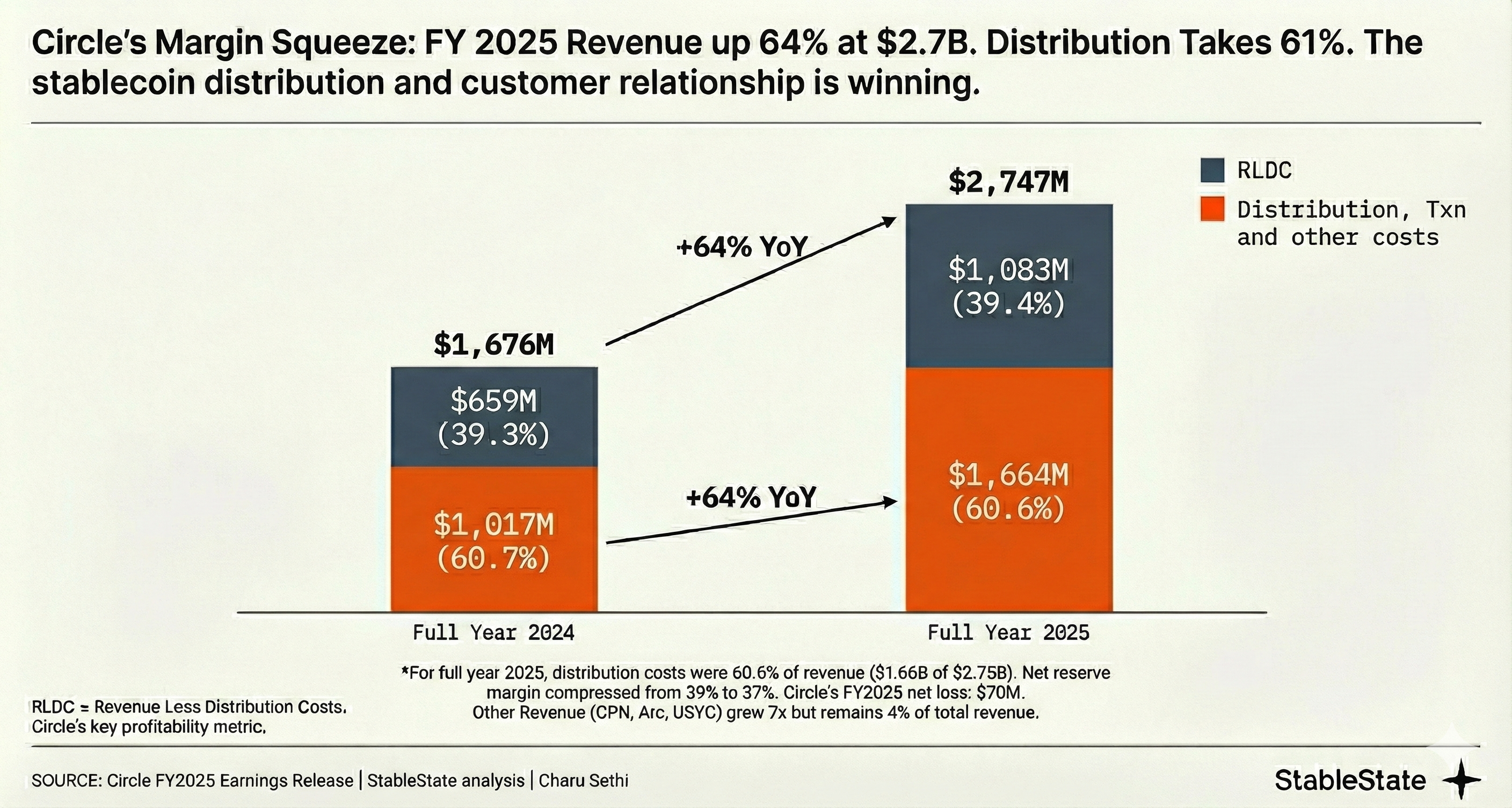
Distribution is where the durable margin lives. Circle paid $1.66 billion (0ver 60% of revenue) in distribution fees in 2025 (up 64% as FY 2025). As Austin Campbell (CEO of WSPN US, former Paxos) put it: stablecoin economics are shifting to paying distributors, which hold the real economic power. The stablecoin itself is a government money market fund.
The market has responded. Western Union announced USDPT on Solana. Klarna launched KlarnaUSD on Tempo (Stripe and Paradigm’s blockchain). JPMorgan’s Kinexys processes $2 billion daily. Ten European banks formed Qivalis for a euro stablecoin under MiCA. Stripe’s Bridge (acquired for $1.1 billion; just received for conditional OCC approval for National Trust Bank charter) launched Open Issuance enabling any business to create a branded stablecoin.
The programmable liquidity layer: the next margin frontier
Here is the insight most stablecoin analysis misses. The roughly $300 billion in stablecoin market cap plus $30 billion+ in tokenised RWAs is not all idle digital cash. It is global trapped liquidity that is now being programmed. The ability to offer yield, lending, and composability on top of stablecoins is becoming the foundation of institutional DeFi; and the next margin pool.
XRPL is building vertically. Ripple bundles payments, stablecoins (RLUSD at $1B+ market cap), lending (XLS-66), permissioned trading, and tokenisation into a single regulatory-friendly ledger. On February 19, 2026, Soil announced their launch of what it calls the first compliant yield protocol on XRPL; enabling RLUSD holders to access 5-7% fixed APR through vaults backed by private credit and tokenised Treasuries. Initial $1 million pools filled in under 72 hours.
Circle is building horizontally. USDC on 30+ chains, CCTP V2 processing $30 billion quarterly, Hashnote for institutional yield, Arc blockchain with Visa as design partner, and x402 for machine-to-machine payments.
JPMorgan is the TradFi champion. JPM Coin is a deposit token; not a stablecoin. It represents a direct claim on bank deposits and can potentially pay interest (deposit tokens fall outside the GENIUS Act’s yield prohibition). $2+ trillion cumulative volume, now deploying on the Canton Network.
The rest of the field is filling in the stack. BlackRock BUIDL ($2.5B AUM, used as collateral on Binance). Ondo Finance ($1.6B TVL in tokenised Treasuries). Fireblocks ($6T in stablecoin volume in 2025). Visa running $3.5B annualised in USDC settlement. Mastercard piloting RLUSD for credit card settlement.
A layered yield architecture is forming: stablecoins for stability, tokenised Treasuries for 3.75-5.3%, DeFi lending for institutional borrowing, and structured platforms like Soil for 5-7%+. The institution that controls the most complete stack captures the most margin.
Three imperatives for CFOs and CROs
Distribution is the franchise, not issuance. Reserve income is real ($40M per $1B in circulation) but commoditising fast. Build or partner for distribution. The on-ramp/off-ramp position is the new correspondent banking franchise.
Programmable liquidity is the next margin frontier. Holding idle stablecoins is the new trapped nostro liquidity. Evaluate which programmable layer your strategy plugs into.
Start with corridor analysis, not technology selection. Your stablecoin strategy begins with where your customers send money and what it costs them today.
The unbundling of correspondent banking is not a future event. The margin is migrating now; the only question is whether it migrates to you, or away from you.
Curiosities for treasury teams watching this space
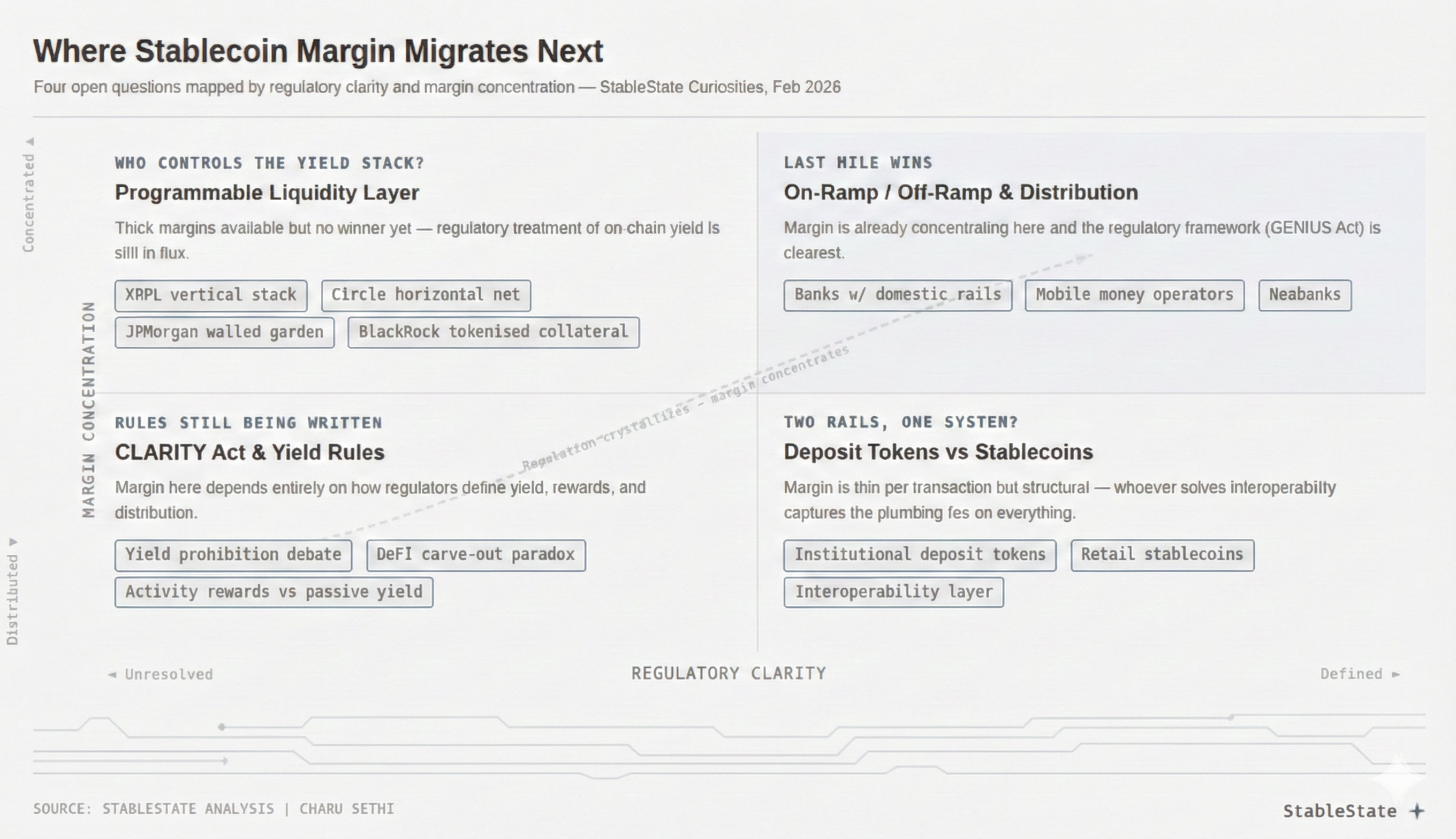
The CLARITY Act could close the yield loophole; or blow it wide open for DeFi. The January 2026 Senate draft would extend the GENIUS Act’s yield prohibition to digital asset service providers, but carve out activity-based rewards like loyalty programmes, liquidity provision, and staking. The paradox: DeFi protocols are explicitly excluded from the definition of “digital asset service provider.” If centralised platforms cannot offer passive yield but DeFi can, volume migrates to protocols like Soil, Aave Horizon, and Ondo. The markup was indefinitely postponed after industry pushback. The final text of both the CLARITY Act and the GENIUS Act’s implementing rules will shape the entire stablecoin margin structure for the next decade; every treasury team should be tracking how regulators define “yield,” “rewards,” and “distribution” in the months ahead.
The on-ramp/off-ramp layer is its own margin pool. Distribution is the franchise, but the institutions that convert between fiat and stablecoins capture 0.5-2% per leg. Banks with strong domestic payment rail access have structural advantages here that pure-play crypto firms cannot replicate. This is where ASEAN banks with real-time payment infrastructure, African mobile money operators, and Latin American neobanks have positioning that no protocol layer can easily disintermediate. Margins migrate to whoever controls the last mile.
Who builds the best programmable liquidity layer will matter more than who issues the most stablecoins. XRPL bets on vertical integration. Circle bets on horizontal breadth. JPMorgan bets on institutional trust. BlackRock bets on tokenised collateral. The market has not picked a winner; these layers may prove complementary rather than competitive.
Deposit tokens versus stablecoins: if major banks adopt deposit tokens while fintechs adopt stablecoins, do we get a bifurcated architecture? Institutional flows on deposit tokens, retail and cross-border on stablecoins. Deposit tokens fall outside the GENIUS Act’s yield prohibition and maintain banks’ lending capacity. If regulators treat them as fundamentally different instruments, the margin structure diverges entirely; and the interoperability question between these two rails becomes the defining infrastructure challenge. Watch OCC and FDIC implementation guidance closely.
More on institutional DeFi components and the yield stack architecture in upcoming posts.
Note: This article has been updated on 25th Feb 2026 to reflect Circle's FY 2025 earnings
Sources
Correspondent Banking and Cross-Border Payments
- BIS CPMI correspondent banking data: bis.org
- McKinsey 2023 Global Payments Report: mckinsey.com
- World Bank Remittance Prices Worldwide Q1 2025: remittanceprices.worldbank.org
- Federal Reserve, “Banks in the Age of Stablecoins” (Dec 2025): federalreserve.gov
Corridor-Specific Data
- Nigeria stablecoin adoption: Chainalysis
- Pacific Islands remittance costs: Lowy Institute
- Myanmar USDT adoption: Ainvest
- Philippines stablecoin pilots: Bitwage
Stablecoin Economics and Commoditisation
- Tether 2024 profit (BDO attestation): tether.io
- Circle S-1 filing and Coinbase distribution costs: Fortune, Coin Metrics
- Austin Campbell on commoditisation: Mercatus Center
- Annual Stablecoin Volume: ArtemisAnalytics
- Circle FY2025 Earnings: Circle Earnings Release
Programmable Liquidity and Institutional DeFi
- Soil RLUSD yield protocol on XRPL (Feb 2026): The Block
- Ripple institutional DeFi on XRPL: ripple.com
- BlackRock BUIDL ($2.5B AUM): CoinDesk
- Fireblocks $6T stablecoin volume: Blockchain News
- Visa stablecoin settlement: investor.visa.com
- Mastercard RLUSD pilot: mastercard.com
White-Label Issuance
- Western Union USDPT: Western Union IR
- KlarnaUSD on Tempo: Klarna IR
- Bridge National Trust Bank charter: CoinSpectator
- JPMorgan Kinexys: jpmorgan.com
- European bank consortium (Qivalis): Cryptonomist
Regulatory
- GENIUS Act: Gibson Dunn
- GENIUS Act yield prohibition analysis: Columbia Law School
- CLARITY Act status and yield debate: Baker McKenzie, Davis Wright Tremaine
- MAS stablecoin framework: mas.gov.sg
Incumbent Response
- SWIFT blockchain-based ledger (34 institutions, Consensys): swift.com
Disclaimer: This article is for informational purposes only and does not constitute financial, legal, or investment advice. Opinions are my own. Stablecoin infrastructure is rapidly evolving; readers should conduct their own due diligence and consult with qualified professionals before making treasury decisions.