Stablecoin Payment Infrastructure 2026, Part 2: Ripple’s Institutional Stack vs Tether’s $187B Global Network — What CFOs Need to Know
Stablecoin infrastructure series Part 2: Ripple’s $4B acquisition-fueled institutional stack (RLUSD, Hidden Road, GTreasury) vs Tether’s $187B emerging-market dominance, Anchorage Digital’s white-labe
TL;DR: Part 1 covered Circle and Stripe - two companies building purpose-built L1 blockchains for payments. This part covers the other two stablecoin giants taking a fundamentally different approach. Ripple spent ~$4B acquiring payments, custody, prime brokerage, and treasury management infrastructure - then launched RLUSD ($1.5B market cap, BNY Mellon custody, dual NYDFS + OCC oversight). Tether dominates through sheer scale: $187B in circulation, 534M users, de facto dollar infrastructure across emerging markets where traditional banking barely functions. Its new USA₮ stablecoin, issued through Anchorage Digital Bank (the only federally chartered crypto-native bank), is Tether’s play for US compliance. The pattern: Ripple is building top-down for institutions. Tether built bottom-up from global demand. Both are now converging toward the middle. Evolving in quarters, not years. Stay updated.
Start Here: Why These Two Ecosystems Matter for CFOs
In Part 1, we covered Circle’s Arc and Stripe’s Tempo — two purpose-built Layer 1 blockchains designed from scratch for payment settlement. Both are in testnet, both target 2026 mainnet, and both represent a “build the highway from scratch” approach to stablecoin infrastructure.
Ripple and Tether took the opposite path. Instead of building new blockchains for payments, they built entire ecosystems — through acquisitions, partnerships, and sheer global scale — around their existing networks. The result is two stablecoin empires that look nothing like each other, and nothing like Circle or Stripe.
Understanding them matters because together with Circle and Stripe, these four players define the infrastructure landscape a CFO will navigate when evaluating stablecoin rails. Ripple offers regulated, vertically integrated institutional plumbing. Tether offers unmatched global liquidity and reach. Neither is a simple “stablecoin issuer” — both are building financial ecosystems that will shape how corporate money moves for the next decade.
Ripple: From Payments Messaging to a $4 Billion Financial Infrastructure Play
The evolution
Ripple’s journey tells the story of an entire industry’s maturation. Founded in 2012, the company spent its first era building xCurrent — a cross-border messaging layer that banks could adopt without touching cryptocurrency. Santander’s One Pay FX and Standard Chartered’s Asia-Middle East settlement both ran on this messaging infrastructure, no XRP involved.
The pivot came with On-Demand Liquidity (2019), which introduced XRP as a bridge currency: sender’s fiat converts to XRP, crosses the XRP Ledger in 3–5 seconds, then converts to destination fiat. By 2024, ODL processed approximately $15 billion annually across 70+ corridor pairs. But the critical nuance: of Ripple’s 300+ financial institution partners across 55+ countries, the majority still use only the messaging layer. XRP-as-bridge usage remains a subset of the network.
In 2023, Ripple quietly dropped the “ODL” branding entirely, repackaging everything as Ripple Payments — signaling a deliberate repositioning from crypto company to enterprise financial infrastructure provider.
The acquisition spree that changed everything
Brad Garlinghouse made the strategy explicit: unlike other crypto companies, Ripple focused on acquiring traditional financial assets. The 2025 numbers back this up:
Hidden Road ($1.25B, closed June 2025): A multi-asset prime brokerage clearing $3+ trillion annually for over 300 institutional clients — instant access to the credit intermediation, clearing, and financing infrastructure that banks and hedge funds depend on daily.
GTreasury ($1B, announced January 2026): A treasury management platform serving 1,000+ enterprises including American Airlines, Goodyear, and Volvo, processing $12.5 trillion in annual payments volume. This is the move that should get CFOs’ attention: Ripple didn’t buy a crypto company — it bought the software your treasury team might already be using. The integration roadmap includes embedding RLUSD-powered payments and real-time FX directly into GTreasury’s existing workflows.
Rail ($200M): Stablecoin-powered B2B payments infrastructure.
Metaco ($250M, 2023): Institutional-grade digital asset custody, serving BNP Paribas, HSBC, Citi, and DBS.
Combined, Ripple now operates a five-pillar structure: Ripple Payments, Ripple Prime (Hidden Road), Ripple Treasury (GTreasury), Ripple Custody (Metaco), and RLUSD. A $500 million funding round in November 2025 valued the company at $40 billion. The company has signaled a pause on M&A through mid-2026 to focus on integration.
The SEC resolution cleared the institutional path
The four-year SEC lawsuit — filed December 2020, alleging $1.3 billion in unregistered securities offerings — consumed over $150 million in legal fees and kept many institutions at arm’s length. The key rulings: XRP sold on secondary markets is not a security (July 2023); institutional direct sales were unregistered offerings. The case fully resolved in mid-2025, with a $50 million settlement, all appeals dropped, and the injunction dissolved.
The regulatory thaw triggered immediate market validation. The first US spot XRP ETF launched in November 2025, followed by products from 21Shares, Franklin Templeton, and Bitwise — collectively reaching approximately $1.37 billion in assets under management by early February 2026.
RLUSD: The Stablecoin Designed for Institutional Plumbing
Launched December 17, 2024 after NYDFS approval, RLUSD has grown to approximately $1.52 billion in market cap as of February 2026. It is issued by Standard Custody & Trust Company, a Ripple subsidiary, and lives natively on both the XRP Ledger and Ethereum.
What matters for CFOs
Reserve quality: 1:1 backed by US dollar cash deposits, short-term Treasury bills, and government money market funds — no corporate bonds, no crypto. BNY Mellon serves as primary custodian. Monthly attestations by Deloitte & Touche — matching Circle’s Big Four standard.
Regulatory standing: Dual NYDFS + OCC oversight, a first for any stablecoin issuer. Ripple secured conditional OCC approval in December 2025 for a Ripple National Trust Bank and has applied for a Federal Reserve master account — which, if approved, would allow reserves to be held directly at the Fed.
Advisory board: Sheila Bair (former FDIC Chair), Raghuram Rajan (former Reserve Bank of India Governor), Kenneth Montgomery (former Federal Reserve Bank of Boston COO).
Distribution: Binance, Coinbase, Kraken, Bitstamp, MoonPay. SBI VC Trade expects to launch RLUSD in Japan during Q1 2026.
The real strategic play is closed-loop integration: RLUSD serves as collateral within Ripple Prime ($3+ trillion annual clearing), as settlement currency in Ripple Payments, and as treasury management rail through GTreasury’s $12.5 trillion payments volume. BlackRock’s BUIDL accepts RLUSD as collateral through Securitize.
At $1.52 billion, RLUSD remains small against USDC’s $77 billion and USDT’s $187 billion. But Ripple’s thesis isn’t about competing on market cap — it’s about being the stablecoin wired directly into institutional plumbing that no competitor controls end-to-end.
Where this contrasts with Part 1
Where Circle built Arc as a new L1 for institutional finance, Ripple is retrofitting the 12-year-old XRP Ledger with institutional DeFi features — confidential transfers, permissioned lending, compliance domains — while simultaneously acquiring traditional finance companies to bring institutions onto its rails. Ripple’s “Blueprint for Institutional DeFi,” published February 2026, positions XRPL as a compliance-first financial operating environment where institutional lending, settlement, and tokenized asset management converge.
Tether: The $187 Billion Empire Built on Emerging-Market Dollar Hunger
Scale that defies comparison
While Ripple targets institutions from the top down, Tether built the world’s largest stablecoin from the bottom up, powered by relentless demand for dollars in countries where the banking system cannot or will not provide them.
USDT’s $187.3 billion market cap commands 60.7% of the global stablecoin market and 82.5% of trading volume. Behind this: 534 million estimated users, 139 million on-chain holders, and 24.8 million monthly active on-chain users — all at record highs as of Q4 2025.
Where traditional banking fails, USDT fills the gap
Over 80% of stablecoin flows occur outside the United States. This geographic reality is what makes Tether strategically irreplaceable for CFOs operating in emerging markets.
In Nigeria, where inflation exceeded 21% in 2025, USDT on Tron has become what analysts describe as the digital dollar. Argentina processed $91 billion in USDT transactions between mid-2023 and mid-2024; Brazil $90 billion; Mexico $70 billion. In the Middle East and Southeast Asia, cross-border B2B settlements using USDT surged past $30 billion in Q1 2025 alone.
The economic rationale is straightforward: Sub-Saharan Africa’s average remittance cost is 8.45% — nearly triple the UN’s 3% target. USDT on Tron costs under $0.01 to transfer and settles in seconds. Yellow Card, operating across 20+ African countries, runs 99% of its business in stablecoins — overwhelmingly USDT.
Ethereum holds roughly $80 billion of USDT supply, preferred by institutions and DeFi protocols. Tron holds a comparable amount, dominating retail remittances and P2P transfers with its near-zero fees.
Where this contrasts with Part 1
Where Stripe’s Tempo is designed for high-volume merchant payments with ISO 20022 memo fields and ERP reconciliation, Tether’s dominance comes from the opposite end — billions in stablecoin transactions across emerging markets, small-ticket remittances at sub-penny costs, with no ERP integration needed because many users don’t have ERPs. Tempo and Tether serve different ends of the same global payments spectrum.
The $10 Billion Profit Machine Behind USDT
Tether reported over $10 billion in net profit for 2025 with approximately 300 employees — one of the highest revenue-per-employee ratios of any company globally. Total reserves stood at $192.9 billion, including a record $141.6 billion in US Treasuries. Tether is now approximately the 18th–19th largest holder of US government debt globally.
CEO Paolo Ardoino has channeled this profit engine into a diversification strategy spanning 120+ companies with over $20 billion invested — all funded from excess capital, segregated from USDT reserves. The five-division structure (Finance, Power, Data, Edu, Evo) spans media (Rumble, $775M), AI infrastructure (Northern Data, ~$1.1B total exposure), agriculture and energy (Adecoagro, $615M), biotech (Blackrock Neurotech, $200M), Bitcoin mining (Bitdeer, $118M+), and gold (Gold.com, $150M).
Each investment creates distribution advantages for USDT — mining investments feed Bitcoin treasury accumulation, payments companies expand settlement rails, and a strategic investment in LayerZero Labs supports USDT0, the omnichain interoperability layer.
The S&P downgrade CFOs cannot ignore
On November 26, 2025, S&P Global Ratings downgraded USDT to “Weak” — the lowest possible score on its 1–5 scale. The rationale: Bitcoin now represents 5.6% of USDT reserves (exceeding the 3.9% overcollateralization margin), 24% of reserves sit in high-risk assets, and transparency on custodians and governance remains limited. Tether has never completed a full independent audit — only quarterly attestations.
For context: USDC holds an S&P “Strong” rating. The downgrade had minimal immediate market impact, but it creates a documented institutional barrier for fiduciary boards evaluating stablecoin counterparty risk.
USA₮ and Anchorage Digital: Tether’s Answer to US Compliance
The GENIUS Act forced Tether’s hand
The GENIUS Act (signed July 2025) requires stablecoin reserves to consist of cash and US Treasuries — no Bitcoin, no gold — plus monthly audited disclosures and issuance only through permitted entities including OCC-supervised banks. USDT’s current reserves don’t align.
USA₮: the compliant US stablecoin
Tether’s solution: USA₮, launched January 27, 2026 through Anchorage Digital Bank — the only federally chartered crypto-native bank in the United States (OCC charter since January 2021). USA₮ is backed 100% by short-term US Treasury bills, custodied by Cantor Fitzgerald.
Critically, Tether Operations is not the issuer — Anchorage Digital Bank issues USA₮ under direct OCC supervision. At approximately $20 million in market cap two weeks after launch, USA₮ is embryonic and faces a massive liquidity challenge against USDC’s $77 billion.
The appointment of Bo Hines as CEO of Tether USA₮ brings direct political connectivity — he served as Executive Director of the President’s Council of Advisers on Digital Assets under Trump before departing in August 2025 and joining Tether ten days later.
Anchorage Digital: The White-Label Stablecoin Factory
The more consequential story may be Anchorage Digital itself. Its white-label stablecoin issuance platform has quietly become the infrastructure behind multiple branded stablecoins, positioning Anchorage as a regulated manufacturing layer for institutional stablecoin issuance.
Four known white-label relationships are in various stages:
USA₮ (Tether): Live since January 2026; backed by T-bills via Cantor Fitzgerald.
USDtb (Ethena Labs): Operational, ~$1.5–2B market cap; reserves primarily in BlackRock’s BUIDL; described as the first GENIUS Act-compliant stablecoin.
USDGO (OSL Group): Announced; targeting Asian institutional payments.
USDPT (Western Union): Expected H1 2026; built on Solana, integrating with Western Union’s 550,000+ retail locations across 200+ countries.
Beyond issuance, Anchorage serves as custodian for BlackRock’s spot crypto ETPs ($50B AUM) and the BUIDL tokenized Treasury fund. Its Atlas settlement network provides 24/7 institutional settlement. Tether reinforced its commitment with a $100 million equity investment in February 2026, valuing Anchorage at $4.2 billion. A consent order for BSA/AML deficiencies, imposed in 2022, was terminated by the OCC in August 2025 after three years of remediation.
Against competitors, Anchorage holds a five-year head start on the OCC charter — BitGo, Circle, Ripple, Fidelity, and Paxos all received conditional approvals only in December 2025. Bloomberg reported Anchorage is seeking $200–400 million in new funding, with a potential IPO in 2026–2027.
Tether’s Technical Bets: USDT0, Plasma, and Hadron
Tether’s technical ambitions extend beyond USDT issuance into three areas worth tracking.
USDT0 is an omnichain interoperability solution built on LayerZero, enabling native USDT transfers across 15+ blockchains via lock-and-mint mechanics. It has processed over $70 billion in cross-chain transfers since launching in January 2025 — settling in 30–40 seconds, up to 70% faster than competing bridges.
Plasma is Tether’s own Layer 1 blockchain, launched September 2025, offering zero-fee USDT transfers. It attracted $5.6 billion in deposits in its first week, though TVL has since declined to approximately $1.8 billion and actual throughput has averaged roughly 14.9 TPS against much higher claims.
Hadron is a tokenization platform for real-world assets — stocks, bonds, commodities, funds — with built-in KYC/KYB/KYT compliance via Crystal Intelligence. Launched November 2024, it represents Tether’s play for the broader tokenized asset market.
Additionally, Tether has announced plans to deploy USDT natively on Bitcoin via the RGB protocol, pursuing Lightning Network compatibility, and open-sourced a Wallet Development Kit already powering the Rumble Wallet.
The Four-Player Landscape: Where Each Fits for Corporate Treasury
Across Parts 1 and 2, four distinct infrastructure approaches have emerged:
Circle — Part 1 (the institutional payment blockchain)
Best for: large treasury flows, regulated corridors, institutional counterparties. Stablecoin: USDC ($77B). Infrastructure: Arc blockchain (testnet), Circle Payments Network (live), CCTP ($126B cumulative). Key advantage: most mature institutional stablecoin ecosystem with NYSE-listed transparency, Deloitte attestations, and conditional OCC approval.
Stripe/Tempo — Part 1 (the commerce payment blockchain)
Best for: high-volume e-commerce, merchant reconciliation, Stripe ecosystem integration. Infrastructure: Tempo L1 (testnet, targeting 100K+ TPS), native ISO 20022 fields, dedicated payment lanes. Key advantage: invisible infrastructure for businesses already on Stripe’s payment stack.
Ripple — Part 2 (the vertically integrated institutional stack)
Best for: cross-border payments (especially Asia-Pacific), treasury management, institutions wanting one vendor for payments + custody + prime brokerage + stablecoin. Stablecoin: RLUSD ($1.5B, BNY Mellon custody, Deloitte attestations, dual NYDFS + OCC). Key advantage: the only player offering payments, custody, prime brokerage, treasury management, and stablecoin issuance under one roof.
Tether/Anchorage — Part 2 (global liquidity and emerging-market access)
Best for: emerging-market operations, B2B settlement in Africa/LATAM/Southeast Asia/Middle East, maximum liquidity depth. Stablecoin: USDT ($187B) + USA₮ ($20M, OCC-supervised). Risk profile: S&P “Weak” rating, no full audit. Key advantage: nothing else comes close to USDT’s global reach, particularly in markets where traditional banking is inaccessible.
What’s Missing: Risks CFOs Need to Model
Counterparty risk divergence. Circle and Ripple are converging on institutional-grade standards (Big Four attestations, federal bank charters, segregated reserves in government securities). Tether carries an S&P “Weak” rating and has never been fully audited. USA₮ addresses this for US operations but is weeks old. Apply different concentration limits depending on which ecosystem you use.
The GENIUS Act reshapes competition differently. For Ripple and Circle, it validates the regulated-first approach. For Tether, it creates a compliance timeline for USDT while motivating USA₮ as a parallel product. USDT’s Bitcoin and gold reserves don’t currently align with GENIUS requirements, though Tether has 18–36 months to adjust.
Scale versus maturity tradeoffs. RLUSD at $1.52 billion has limited secondary market liquidity. USA₮ at $20 million is effectively untested. USDT’s $187 billion scale comes with governance opacity. There is no single “safe” choice — only choices with different risk distributions.
The Bottom Line
Part 1 showed how Circle and Stripe are building new payment highways from scratch — purpose-built blockchains optimized for settlement speed, compliance, and commercial transactions.
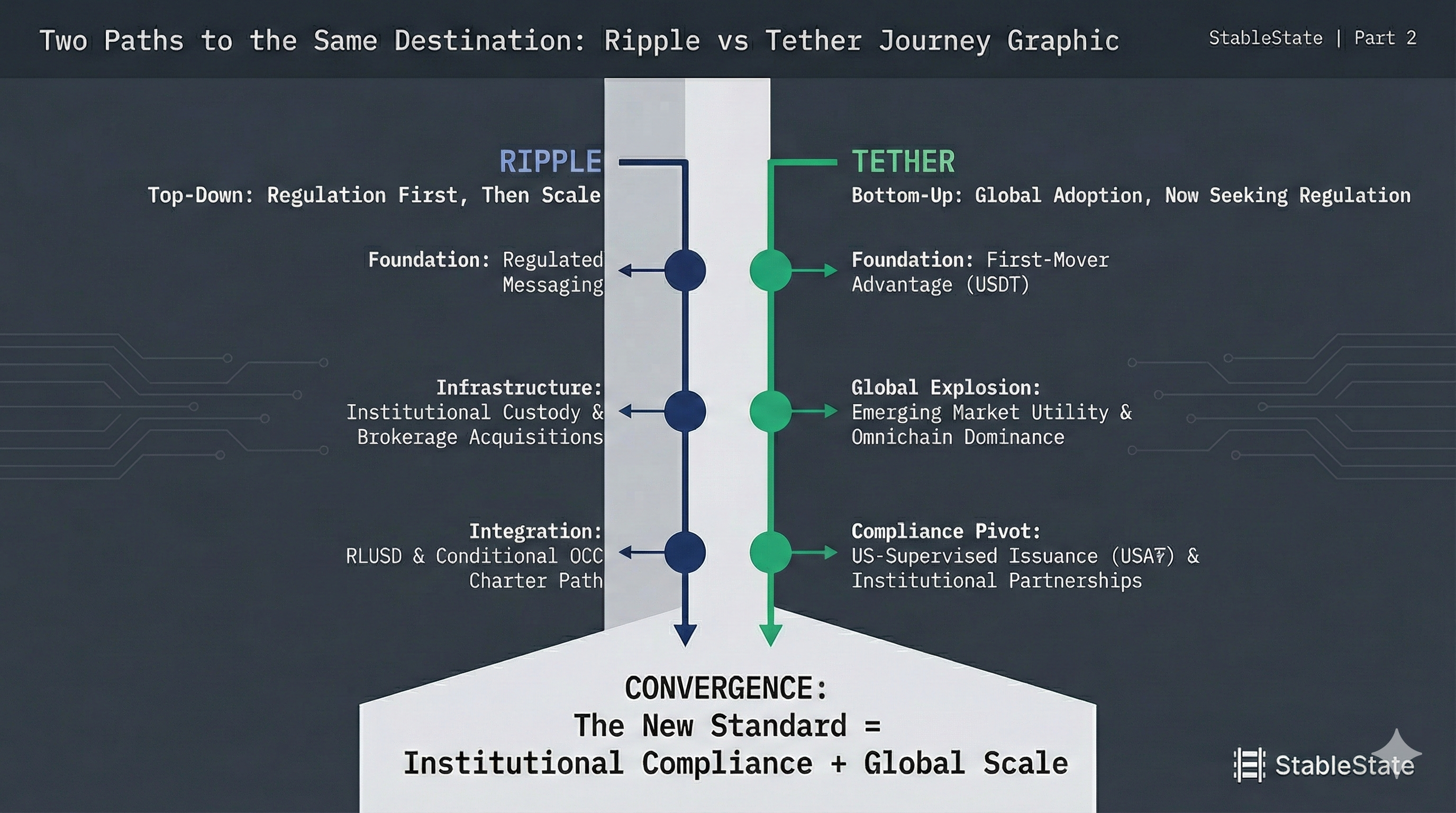
This Part shows how Ripple and Tether built empires through acquisition and global adoption. Ripple started with regulation and is building toward scale. Tether started with scale and is building toward regulation. The wild card is Anchorage Digital, whose white-label model — now powering stablecoins for Tether, Ethena, OSL, and Western Union — could become the standard factory for institutional stablecoin issuance.
The convergence point — where institutional compliance meets global scale — is where the real opportunity lies for CFOs building stablecoin capability now.
As I mentioned in my previous article, treat stablecoins as utility, not hype. You don't need to be an expert; just stay aware enough to spot the opportunities and dodge the risks.
Note: As of 12th February, 2026 the American Bankers Association asked the Office of the Comptroller of the Currency (OCC) to delay additional crypto trust bank charter approvals until Congress finalizes stablecoin and broader digital asset rules. This is an evolving situation.
Further Reading and Sources
Ripple
- Ripple Payments and solutions overview: ripple.com
- RLUSD stablecoin and reserve details: ripple.com/solutions/stablecoin
- BNY Mellon RLUSD custody announcement: bny.com
- OCC conditional approval for Ripple National Trust Bank: occ.gov
- Hidden Road acquisition: ripple.com
- GTreasury acquisition: gtreasury.com, Architect Partners analysis
- Institutional DeFi blueprint: CoinDesk
- SEC settlement: CoinDesk, SEC.gov
- XRP spot ETF: Yahoo Finance
- Metaco acquisition: TechCrunch
- RLUSD market data: Coinbase
- SBI Japan distribution plans: ripple.com
Tether / USDT (Data as of Q4 reports)
- Q4 2025 financial results and reserves: tether.io
- Q4 2025 user growth: The Coin Republic
- USDT market dominance: MEXC
- Usage statistics: CoinLaw
- Stablecoins in Africa: Cointelegraph, AiCoin
- S&P downgrade: CoinDesk, Blockhead
- 120+ portfolio companies: The Coin Republic, BeInCrypto
- Rumble investment: tether.io
- LayerZero investment: tether.io
USA₮ and Anchorage Digital
- USA₮ launch: tether.io, CoinDesk
- Bo Hines background: Fortune
- Anchorage stablecoin platform: anchorage.com
- USDtb (Ethena): anchorage.com
- USDGO (OSL): anchorage.com
- USDPT (Western Union): Western Union IR
- Tether $100M equity investment: CoinDesk, American Banker
- BlackRock custodian partnership: anchorage.com
- OCC consent order termination: Banking Dive
- IPO reports: BitcoinEthereumNews
Tether Technical Infrastructure
- USDT0 omnichain: Eco, The Block
- Plasma Layer 1: The Block
- Hadron platform: tether.io, hadron.tether.to
Market Data and Regulatory
- Stablecoin market overview: MEXC
- XRPL RWA tokenization growth: 24/7 Wall St
- Stablecoin treasury management: AlphaPoint
Previous Article: Stablecoin Payment Infrastructure 2026: What CFOs Need to Know About Arc, Tempo and the Last-Mile Problem
Disclaimer: This article is for informational purposes only and does not constitute financial, legal, or investment advice. Opinions are my own. Stablecoin infrastructure is rapidly evolving, and readers should conduct their own due diligence and consult with qualified professionals before making treasury decisions.