Stablecoin Payment Infrastructure 2026: Part 1 — What CFOs Need to Know About Arc, Tempo and the Last-Mile Problem
Stablecoin payment infrastructure 2026: Circle’s Arc vs Stripe’s Tempo blockchains, real cross-border costs (1.5-3.5% traditional vs 0.5-2% stablecoins), and orchestration platforms solving compliance
TL;DR: Traditional cross-border payments cost 1.5-3.5% and take 2-4 days. Stablecoin infrastructure cuts this to 0.5-2% with sub-3-minute settlement. Circle is building the economic OS (Arc blockchain in testnet, Circle Payments Network live at $3.4B annualized). Stripe/Paradigm are building Tempo (payments-first L1, $500M raised at $5B valuation). Xweave and Cybrid handle last-mile compliance. The pattern: Circle and Stripe build the highways, StraitsX builds on/off-ramps, Xweave/Cybrid build the GPS. Evolving in quarters, not years. Stay updated.
This is Part 1 of a series on stablecoin infrastructure for CFOs. Part 2 covers Ripple and Tether — two ecosystems taking radically different approaches to the same problem.
Start Here: What Problem Are Stablecoins Actually Solving?
A few weeks ago, i attended the launch event for the report - “Payments’ state of play 2026 - Shifts redefining Singapore’s payment ecosystem” a joint report by PWC and Singapore Fintech Association. The authors and panelists spent most time discussing which stablecoin will win. That led me to explore the stabecoin infrastructure stack as its shaping today.
You initiate a payment from Singapore to Thailand. Your bank debits your account immediately. 2-4 business days later, the funds arrive—minus FX markups (typically 1-2% over mid-market rates) and layered fees. Worse: your capital sits frozen in correspondent banking limbo for days, earning nothing. You have limited visibility into which institutions touched your money or why deductions occurred.
This isn’t a technology problem. It’s an architectural problem inherited from the 1970s SWIFT era, designed for telex communication and batch settlement cycles.
The World Bank’s Remittance Prices Worldwide database (Q1 2025) confirms banks remain the most expensive remittance channel globally at 14.55% average cost for $200 transfers, versus 6.49% global average across all provider types. However the cost in South Asia is much lower at 4.8%.
Circle and Stripe are building purpose-built Layer 1 blockchains for this transit layer — which is why we start with them. Part 2 covers how Ripple and Tether are approaching the same challenge through existing networks, ecosystem scale and more.
The stablecoin alternative: architecture, not iteration
The stablecoin payment model replaces correspondent banking’s multi-hop architecture with a three-step flow:
- Entry gate: Your SGD enters the system through a regulated partner (e.g., StraitsX, Xweave, or Cybrid)
- Transit layer: Instant conversion to USDC or another stablecoin, moving at internet speed over blockchain networks optimized for payments
- Exit gate: Conversion to Thai Baht and settlement into the recipient’s local bank account via a local partner
The key insight: Instead of moving “money through banks,” you’re moving “data that represents money” through networks optimized for speed, transparency, and programmability. Settlement happens in under 3 minutes, not days. Fees run 0.5-2% total (including on/off-ramp conversion), not 1.5-3.5%.
The infrastructure enabling this shift is no longer experimental. It’s operational in production—and evolving rapidly.
The Infrastructure Landscape: Not Layers, But Strategic Choices
Understanding stablecoin payment infrastructure requires mapping who does what—not as abstract “layers” but as distinct strategic choices for building treasury operations.
The landscape breaks into two primary infrastructure decisions (which blockchain settlement rail to use) and two orchestration decisions (which platform handles compliance, routing, and local integration). In this post I have covered Circle and its Layer 1 (L1) Blockchain—Arc; Tempo the L1 by Stripe and Paradigm, StraitsX and a few orchestration platforms. In subsequent posts I will talk more about other players in the ecosystem like XRPL by Ripple, Anchorage Digital and more.
Infrastructure Decision 1: Circle’s Economic OS for the Internet
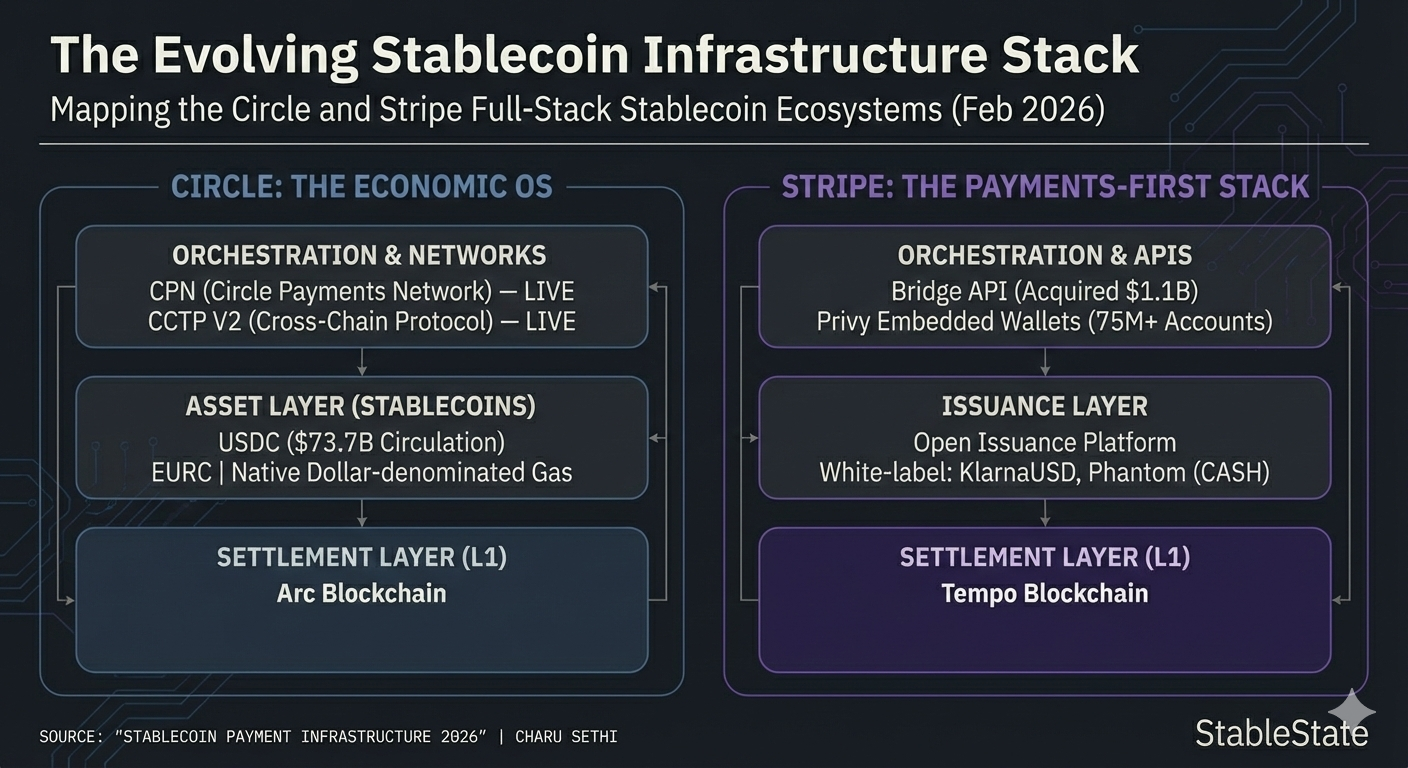
Circle transitioned from “crypto startup” to publicly traded financial infrastructure company on June 5, 2025 (NYSE: CRCL), raising $1.05 billion at a $6.8 billion valuation. Q3 2025 results showed $740 million in revenue and reserve income (+66% YoY), with USDC circulation reaching $73.7 billion (+108% YoY).
Circle CEO Jeremy Allaire consistently frames the company’s mission as building “the Economic OS for the internet”—a foundational infrastructure layer for digital commerce, not just a stablecoin issuer.
Circle’s ecosystem as of February 2026:
Circle Payments Network (CPN) ; LIVE, OPERATIONAL.
Mainnet launched May 21-23, 2025. CPN connects financial institutions for real-time cross-border settlement using USDC and EURC. As of Q3 2025: 29 institutions enrolled, 55 in eligibility review, 500 in pipeline, spanning 8 countries with $3.4 billion annualized transaction volume. Early adopters include Alfred Pay, Tazapay, RedotPay, and Conduit. Advisory partners include Banco Santander, Deutsche Bank, Société Générale, and Standard Chartered.
Cross-Chain Transfer Protocol (CCTP) ; LIVE, OPERATIONAL.
CCTP V2 became the canonical version on November 14, 2025, enabling permissionless, native USDC transfers between blockchains via burn-and-mint mechanics (no wrapped tokens or liquidity pools). As of December 2025: $126 billion cumulative volume, 5.3 million+ transfers, connecting 19 blockchains. V2 introduced Fast Transfer (sub-minute settlement versus 13-19 minutes from Ethereum on V1), Hooks (automated post-transfer actions), and a Forwarding Service.
Arc blockchain - PUBLIC TESTNET (mainnet targeted for 2026).
Arc is Circle’s Layer 1 blockchain purpose-built for institutional stablecoin finance. Announced August 2025; public testnet launched October 28, 2025. In its first 90 days, the testnet processed 150 million+ transactions across 1.5 million transacting wallets.
Key technical specifications:
- Deterministic sub-second finality (~0.5 seconds average on testnet)
- Fully EVM-compatible (Ethereum tooling, Solidity contracts)
- USDC as native gas token (no need to hold volatile cryptocurrencies for transaction fees—fees are denominated in dollars)
- Opt-in configurable privacy and built-in institutional FX engine
Over 100 launch participants include BlackRock, BNY Mellon, Goldman Sachs, Visa, Mastercard, Coinbase, AWS, and Anthropic. Circle is “exploring the possibility of launching a native token” on Arc. Mainnet beta is expected in 2026 but no specific date has been confirmed.
StableFX — ON TESTNET (production launch tied to Arc mainnet).
An institutional-grade stablecoin FX engine combining Request-for-Quote execution with 24/7 on-chain settlement on Arc. It enables institutions to receive quotes from multiple liquidity providers and settle automatically on-chain. Circle Partner Stablecoins (companion program) supports non-USD stablecoins from issuers including Avenia (BRLA), JPYC (JPYC), Coins.ph (PHPC), Forte (AUDF), and others. Circle cautions: “All product features may be modified, delayed, or cancelled without prior notice.”
Circle’s 2026 roadmap priorities (published January 29, 2026):
- Push Arc toward production mainnet
- Expand CPN to more countries (targeting Nigeria, EU, UK, Colombia, India, UAE, China, Turkey, Philippines, Vietnam, Argentina)
- Expand CCTP transaction limits from $1M to $10M
- Launch Bridge Kit for integration “in under 10 lines of code”
The strategic value proposition: Circle offers the deepest institutional liquidity, the most mature cross-chain infrastructure, and a publicly traded entity with transparent financials. If you’re moving millions in treasury flows and need regulatory confidence, Circle’s ecosystem is purpose-built for you.
Infrastructure Decision 2: Stripe’s Full-Stack Stablecoin Play—Bridge, Tempo, and the Payments-First Thesis
Stripe didn’t dip a toe into stablecoins. Over 16 months, it executed a systematic acquisition-and-build strategy to assemble arguably the most vertically integrated stablecoin infrastructure stack in the industry.
The Acquisition Spree: Assembling the Stack
Bridge ($1.1B, Oct 2024 / closed Feb 2025): Stripe’s largest-ever acquisition gave it stablecoin orchestration APIs—letting businesses send, receive, store, and convert stablecoins without touching blockchain complexity. Bridge handles reserve management, multi-chain settlement, compliance, and fiat on/off-ramps.
Privy (June 2025): Embedded wallet provider (75M+ accounts, 1,000+ developer teams) solving the user-facing crypto onboarding problem—no seed phrases, browser extensions, or gas token management required.
Valora team acqui-hire (Dec 2025), Ithaca acqui-hire (Oct 2025), $25M investment in Commonware (Nov 2025): Rounding out blockchain wallet, consensus infrastructure, and on-chain developer tooling expertise.
Dankrad Feist (Oct 2025): Prominent Ethereum Foundation researcher joining Tempo’s development—signaling the level of protocol-design ambition.
Bridge in Production: What’s Already Shipping
This is where CFOs should pay attention—not testnet promises, but live products:
Stablecoin Financial Accounts (May 2025). Businesses in 101 countries can hold dollar-backed stablecoin balances (USDC and Bridge’s USDB), receive funds on both crypto and fiat rails (ACH, SEPA, wire, crypto wallets), and send stablecoins globally. Primary use case: businesses in volatile-currency countries gaining stable dollar-denominated accounts with cheaper cross-border movement. Bridge also partnered with Visa on stablecoin-enabled cards, letting fintechs issue Visa cards linked to stablecoin wallets for spending at 150M+ merchant locations worldwide.
Open Issuance (September 2025). Any business can launch its own branded stablecoin in days. Bridge handles reserves (backed by BlackRock, Fidelity, Superstate), compliance (GENIUS Act-ready), and cross-stablecoin liquidity. All coins on the platform are interoperable through a shared liquidity network. Critically, businesses own their stablecoin economics—earning rewards from origination instead of paying fees to incumbent issuers. Live issuances include Phantom (CASH), Hyperliquid (USDH), MetaMask (mUSD), Sui (USDsui), and others.
Payoneer partnership (Feb 17, 2026). Payoneer is embedding Bridge-powered stablecoin workflows directly into its platform for nearly 2 million cross-border businesses—launching Q2 2026. This illustrates Bridge’s strategic distribution model: Stripe doesn’t need every end-customer to come through Stripe. By powering stablecoin capabilities inside platforms that already own the customer relationship, it scales adoption through partners. Payoneer’s SMB base—heavily concentrated in emerging markets where dollar access and FX costs are acute—is precisely the use case stablecoins were designed for.
OCC National Trust Bank Charter (conditional approval, Feb 12, 2026). Bridge received conditional approval to organize a federally chartered national trust bank—authorizing custody, stablecoin issuance, and reserve management under direct federal oversight. This positions Bridge inside the GENIUS Act framework (signed into law July 18, 2025) alongside Circle, Ripple, Paxos, and others who received conditional approvals in December 2025. The regulatory moat this creates is significant for enterprise buyers evaluating infrastructure partners.
Tempo—The Settlement Layer Underneath
With Bridge handling orchestration, issuance, and compliance, Tempo is the purpose-built settlement blockchain Stripe is constructing underneath.
Jointly incubated with Paradigm as an independent company (led by Matt Huang), Tempo exists because Stripe concluded that existing blockchains aren’t optimized for payments—general-purpose chains suffer from congestion, volatile gas fees, and missing enterprise reconciliation features.
Status: Public testnet launched December 9, 2025. Mainnet expected 2026, no specific date. Raised $500M Series A at $5B valuation (October 2025).
What makes it payments-first:
- No volatile gas token: Fees payable in any supported stablecoin via built-in Fee AMM
- TIP-20 standard: ISO 20022-compatible memo fields for invoice IDs and cost centers—enabling real-time ERP reconciliation at the protocol level
- Dedicated payment lanes: Protocol-level reserved blockspace for payments (your treasury flows don’t compete with NFT mints)
- Built-in stable asset DEX and protocol-level compliance tools (blocklists/allowlists)
Design partners (40+): Anthropic, Coupang, Deutsche Bank, DoorDash, Kalshi, Klarna, Mastercard, Mercury, Nubank, OpenAI, Revolut, Shopify, Standard Chartered, UBS, Visa. KlarnaUSD is the first bank-issued stablecoin planned for the network.
The compliance risk to track: In early February 2026, reports surfaced that Bridge services had been linked to transactions involving sanctioned entities. While Stripe characterized this as not widespread, it illustrates a structural challenge: stablecoins on public blockchains create new compliance risk categories that differ from traditional card-network monitoring. The OCC charter and GENIUS Act compliance address this structurally, but CFOs should model it as ongoing operational risk.
The Strategic Value Proposition
Stripe’s combined stack—Bridge (orchestration/issuance, live), Privy (wallets, live), Stablecoin Financial Accounts (101 countries, live), Open Issuance (white-label stablecoin platform, live), Tempo (settlement blockchain, testnet), and OCC bank charter (conditional)—means the stablecoin layer is designed to become invisible infrastructure for businesses already on Stripe’s payment stack: faster settlements, lower FX costs, automated reconciliation, same API.
If you’re scaling global e-commerce and already use Stripe, Tempo aims to disappear into your existing workflow. If you’re a platform like Payoneer serving cross-border SMBs, Bridge provides the infrastructure to embed stablecoin capabilities without building compliance and blockchain complexity in-house.
Orchestration Decision 1: StraitsX—Southeast Asia’s Regulated Gateway
StraitsX is primarily a stablecoin issuer, but it also provides payment infrastructure through its “StraitsX ON” open network. This dual role is critical to understand.
Stablecoin issuance:
- XSGD (Singapore Dollar stablecoin, ~$13.8M market cap, 8 Feb 2026)
- XUSD (US Dollar stablecoin, ~$44.9M market cap, 8 Feb 2026)
Multi-chain availability: XSGD is available on Ethereum, Zilliqa, XRP Ledger, Polygon, Arbitrum, Base, Avalanche, and Hedera, with Solana targeted for early 2026 (announced December 2025). XUSD is on Ethereum and BNB Smart Chain.
Regulatory standing: StraitsX holds four Major Payment Institution (MPI) licenses from the Monetary Authority of Singapore (MAS) and is a subsidiary of Fazz Financial Group. Both XSGD and XUSD received in-principle approval under MAS’s Single Currency Stablecoin (SCS) regulatory framework, finalized August 15, 2023. Monthly independent reserve attestation reports are published.
The strategic value proposition: StraitsX is the dominant regulated on-ramp in Southeast Asia, bridging local payment rails (Singapore’s FAST, Thailand’s PromptPay, Indonesia’s local banking) into the stablecoin ecosystem. Combined on-chain transaction volume exceeds $18 billion (as of Dec 2025). If your payment flows focus on ASEAN corridors and you need a licensed, MAS-regulated partner, StraitsX is purpose-built for this.
Orchestration Decision 2: Xweave and Cybrid—Last-Mile Compliance Platforms
The hardest part of stablecoin payments isn’t the technology—it’s the messy reality of converting Singapore Dollars to USDC, routing through the optimal network, converting to Thai Baht, and depositing into a Bangkok bank account while staying compliant with MAS, SEC, Thai FinTech regulations, and your auditor’s requirements. This is where orchestration platforms live.
Xweave (Singapore) — Founded 2024, incubated by Menyala (Temasek venture studio), raised $3 million seed in May 2025. Xweave is a non-custodial, asset-agnostic orchestration platform. It doesn’t hold your money or manage compliance directly—it connects you to regulated VASP (Virtual Asset Service Provider) partners and intelligently routes each transaction through the most cost-effective path. Its routing engine scans multiple stablecoins and on/off-ramps in real time. Launched operations in December 2024 with real-time payments between Singapore and the Philippines. Expansion planned to UAE, Indonesia, Japan, and Hong Kong.
Cybrid (Toronto) — Founded 2021, raised $10 million Series A in October 2025. Unlike Xweave, Cybrid is vertically integrated: it bundles payment orchestration, embedded KYC/KYB/AML compliance, fiat on/off-ramps, MPC custody, and MSB licensing coverage. If you operate in the US or Canada, your team can explore Cybrid’s infrastructure without needing your own Money Services Business license. Cybrid is MSB-registered with FINTRAC and registered with the Ontario Securities Commission.
The difference: Xweave is a lightweight, non-custodial router focused on ASEAN. Cybrid is a full-stack platform with embedded compliance focused on North America.
The strategic value proposition: You’re not going to build this in-house. Even if you have the engineering talent, regulatory compliance changes every quarter. These orchestration layers exist because someone needs to wake up every day tracking MAS circulars, FinCEN guidance, and EU MiCA regulations. Let them.
The Decision Framework: Mapping Use Cases to Infrastructure Stacks
If your primary goal is institutional treasury operations (large, infrequent flows, millions per transaction):
Potential stack: Circle Arc + CPN + Cybrid/Xweave
Why this matters: You need deep institutional liquidity (29+ enrolled FIs in CPN), regulatory confidence from a publicly traded entity, and sub-second deterministic settlement for capital efficiency. Arc’s USDC-denominated gas fees eliminate the volatility risk of holding native blockchain tokens.
If your primary goal is global e-commerce scaling (high volume, small transactions, thousands of payments daily):
Potential stack: Stripe Tempo
Why this matters: Tempo is purpose-built for merchant reconciliation with TIP-20’s ISO 20022-compatible memo fields. If your payment stack already runs on Stripe, Tempo aims to become invisible infrastructure—faster settlements, lower FX costs, automated invoice matching, through APIs.
If your primary goal is ASEAN expansion (localized payments across Singapore, Thailand, Indonesia, Philippines):
Potential stack: StraitsX (XSGD) + Xweave
Why this matters: You need licensed connectivity to local rails (FAST, PromptPay, local banking) and someone who understands ASEAN regulatory nuances. StraitsX holds four MPI licenses from MAS and has in-principle SCS approval. Xweave’s routing engine optimizes across multiple ASEAN corridors.
The pattern: Circle and Stripe are building the highways (Layer 1 blockchains). StraitsX is building on-ramps, off-ramps, and toll-booth systems (stablecoin issuance + infrastructure). Xweave and Cybrid are building the GPS navigation and compliance checkpoints (orchestration + regulatory coverage). More players and offerings will emerge in this fast-evolving landscape.
Missing from this framework: emerging-market dollar access and institutional ecosystem plays from Ripple and Tether. We cover those in Part 2.
What’s Missing From This Picture: The Risks CFOs Need to Model
Let’s be honest about what’s not fully solved yet.
1. Regulatory uncertainty (especially in the US)
Singapore’s MAS finalized its Single Currency Stablecoin (SCS) framework on August 15, 2023, with full implementation expected by mid-2026. Requirements include reserves ≥100% of coins in circulation, monthly independent attestation, and redemption at par within 5 business days. Three entities received in-principle SCS approval: StraitsX (XSGD), StraitsX (XUSD), and Paxos Digital Singapore.
The US is still working through federal stablecoin legislation as of February 2026. This will clarify in the coming weeks and months.
Mitigation: Work with partners (like Cybrid or Xweave) who have legal teams tracking regulatory developments daily. Don’t build regulatory logic into your own systems—outsource this risk.
2. Interest rate sensitivity
Circle’s Q3 2025 revenue was 96% dependent on reserve income—interest earned on the cash and Treasury securities backing USDC. Their reserve return rate was 4.15% in Q3. This creates direct exposure to Federal Reserve policy shifts.
Mitigation: Treat stablecoins as one treasury component, not a replacement for traditional banking relationships.
3. Implementation requirements
Adopting stablecoin rails requires treasury policy updates, ERP integration, and staff training. Most organizations pilot a single payment corridor for 60-90 days before scaling.
Mitigation: Start with one high-pain corridor. Measure cost savings and settlement speed for one quarter before expanding.
The Bottom Line: Keep an Eye Out, Stay Updated
The infrastructure layer is maturing rapidly. Circle is no longer a “crypto startup”—it’s a publicly traded company generating $740M in quarterly revenue, building an “Economic OS for the internet.” Stripe entering with Tempo (backed by $500M at a $5B valuation) signals that stablecoin rails are becoming mainstream financial infrastructure, not speculative experiments.
The last-mile problem is being solved. Companies like Xweave and Cybrid exist precisely because compliance and local integration are hard. They’re doing the unglamorous work of making this usable for businesses that don’t want to become blockchain experts.
This space is evolving in quarters, not years. What’s true in Q1 2026 may change by Q3 2026. Arc and Tempo are both in testnet with mainnet targeted for 2026. New rails will launch. Regulations will shift.
Your job isn’t to become a stablecoin expert—it’s to stay informed enough to recognize when this becomes a competitive advantage versus a compliance risk.
Keep an eye out. Stay updated. This is infrastructure, not speculation.
Next: how Ripple’s $4 billion acquisition spree and Tether’s $187 billion global footprint are building competing visions for the same future.
Further Reading and Sources
Circle
- Circle Q3 2025 Earnings Release (November 12, 2025)
- Circle’s 2026 Product Vision (January 29, 2026)
- Arc Public Testnet Launch (October 28, 2025)
- Circle Payments Network Mainnet Launch (May 2025)
- CCTP V2 Documentation
Stripe / Bridge / Tempo
Acquisitions & Hires:
- Bridge acquisition ($1.1B, closed Feb 4, 2025) — Stripe Newsroom
- Bridge acquisition — CNBC
- Bridge acquisition — TechCrunch
- Privy acquisition (June 2025) — Bloomberg
- Privy acquisition — CoinDesk
- Privy acquisition — Blockworks
- Privy acquisition — DL News
- Ithaca acqui-hire (October 2025) — Paradigm
- Commonware $25M investment (November 2025) — Fortune
- Dankrad Feist hire (October 2025) — Fortune
- Valora team acqui-hire (December 2025) — CoinDesk
Bridge Products in Production:
- Stablecoin Financial Accounts (May 2025) — Stripe Blog
- Stablecoin Financial Accounts — Stripe Newsroom (Sessions 2025)
- Stablecoin Financial Accounts — Bloomberg
- Stablecoin Financial Accounts — PYMNTS
- Open Issuance (September 2025) — Stripe Blog
- Open Issuance — Stripe Newsroom (Tour New York 2025)
- Open Issuance — Fortune
- Sui USDsui on Open Issuance (November 2025) — CoinDesk
- Bridge-Visa card partnership — PYMNTS
Payoneer Partnership (February 2026):
- Payoneer press release (Feb 17, 2026) — Investor Relations
- Payoneer press release — PR Newswire
- Payoneer stablecoin capabilities — PYMNTS
- Payoneer Bridge rollout — Finextra
- Payoneer CFO on stablecoin strategy (Feb 9, 2026) — Payments Dive
OCC Bank Charter (February 2026):
- Bridge conditional OCC approval — CoinDesk
- Bridge bank charter — Bloomberg
- Bridge national bank charter — Decrypt
- Bridge OCC approval — The Block
- Bridge federal bank charter — PYMNTS
Tempo Blockchain:
- Tempo announcement (September 2025) — Paradigm
- Tempo announcement — TechCrunch
- $500M Series A at $5B valuation (October 2025) — Fortune
- Public testnet launch (December 2025) — CoinDesk
- Testnet launch — DL News
- Testnet launch & partners — CoinLaw
- Tempo Documentation
Compliance Risk:
Regulatory Frameworks
- GENIUS Act signed into law (July 18, 2025) — White House Fact Sheet
- GENIUS Act — Congress.gov
- GENIUS Act analysis — Latham & Watkins
- GENIUS Act analysis — Mayer Brown
- MAS Single Currency Stablecoin Framework
Cross-Border Payment Costs
- World Bank Remittance Prices Worldwide (Q1 2025)
- BIS SWIFT gpi Data
- Singapore-Thailand PayNow-PromptPay Linkage — World Economic Forum
Supplementary Context
- a16z Crypto: Making Sense of Stablecoin News
- Privy CEO interview (January 2026) — The Defiant
- Payoneer-Citi blockchain partnership (August 2025)
- Artemis Stablecoin Payments Report
- Payments State of Play Report
Orchestration Platforms
Images are AI generated
Disclaimer: This article is for informational purposes only and does not constitute financial, legal, or investment advice. Opinions are my own. Stablecoin infrastructure is rapidly evolving, and readers should conduct their own due diligence and consult with qualified professionals before making treasury decisions.